

Last updated: September 23, 2026

In the eye of the storm
Some events are so momentous that they divide personal history into before and after. For Jason Canney, managing director of Paderborn, Germany-based construction equipment manufacturer Moog, that turning point was May 20, 2022: "I'll remember that day for the rest of my life. It was a normal Friday until the company closed for the day. But around 5.30 pm - Canney had just gotten home - he received an alarming call from a colleague: "A tornado has ripped the roof off our building." The CEO immediately drove back to the company. When he arrived at the industrial park where his company is located, he was greeted by an apocalyptic scene: downed fences, destroyed walls, torn off roofs, broken glass, puddles of rainwater in the ruins of the building... "My first thought was: That's it for the company. The work of the last 30 years was destroyed in a few minutes by a tornado.”
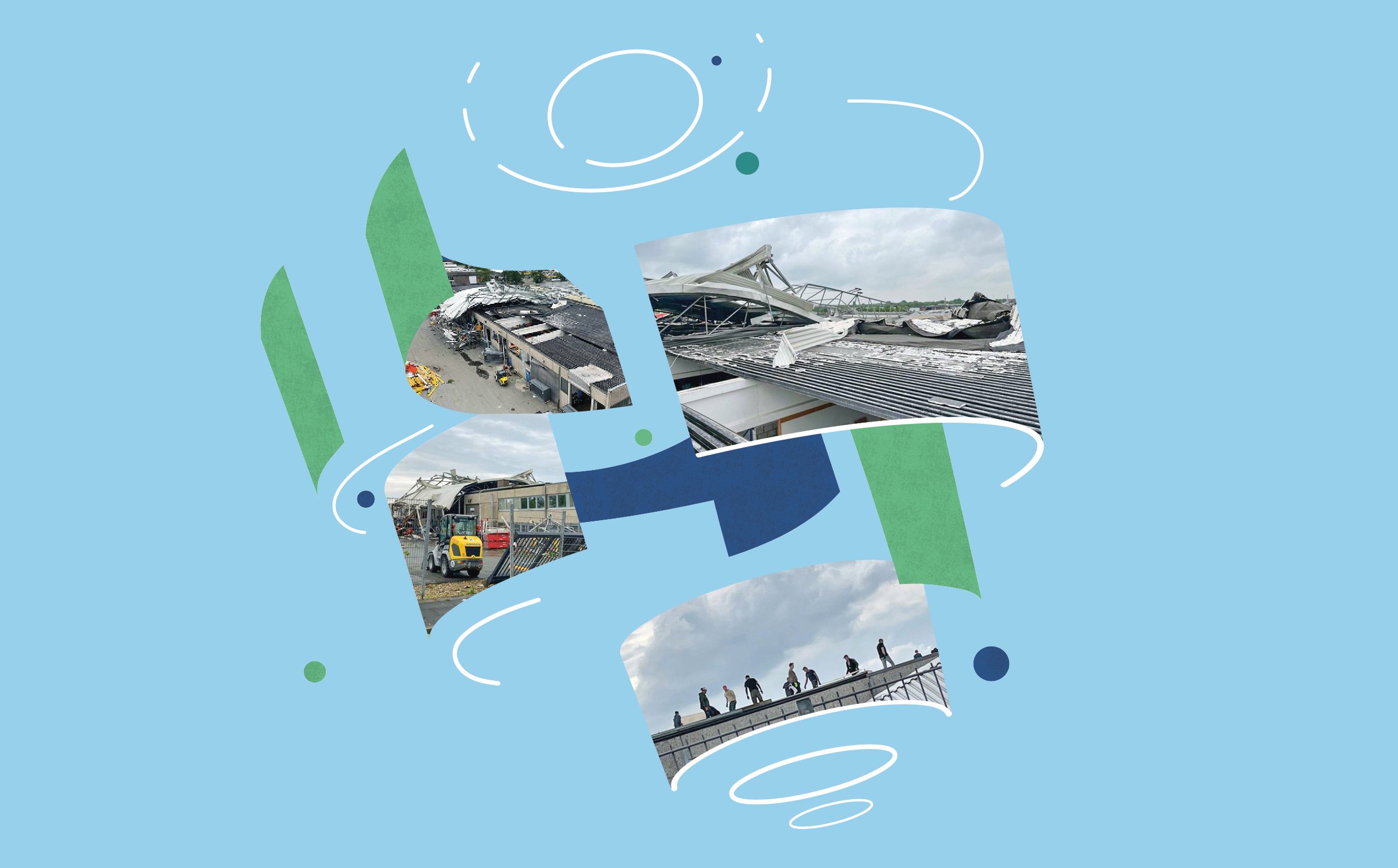
But the next moment, Canney looks around and notices something else: Many of his employees have come back to work on their own accord this Friday night and are, of course, busy with the initial safety and cleanup work. It's a blessing in disguise: Moog is in the construction business, they have the right equipment and people who know how to use it. "Seeing how determined our people were gave me the strength to say, 'We're going to get through this weekend together. And Monday at 7.00 am, we're going to open up again!"
Today, more than three years after the tornado, Jason Canney looks back with mixed feelings. He and his team have been through some very difficult times. It took almost exactly three years to repair the last of the damage, although the company was able to reopen its doors the Monday after the tornado thanks to the outstanding efforts of its employees. Lengthy permitting processes and supply shortages due to the coronavirus pandemic caused repeated delays in construction.
Fortunately, there is one thing the managing director does not have to worry about during these stressful years: the reconstruction costs of around 1.3 million euros. These are covered by Allianz's building and contents insurance, and punctual installment payments ensure a predictable cash flow throughout.
Alexander Kriegel, a major claims adjuster at Allianz Versicherungs-AG, accompanied the process from start to finish. Supported by a construction expert who works for both the client and the insurance company in a so-called advisory board procedure, Kriegel was on site on Monday morning to inspect the damage. "I watched the media coverage of the tornado and went right to work. In my job, you always keep an eye on the weather forecast and local fire department reports. We had to organize a proper inspection tour in the Paderborn area as several of our customers in the region were affected.”
Alexander Kriegel is still impressed by the safety and cleanup work the Moog team did over the weekend to prevent even more damage. "The photos that Moog took to document the damage show the full extent of the devastation. But by Monday morning, everything looked clean enough to eat off the floor. During their conversation, Kriegel is able to convey a positive feeling to Moog CEO Jason Canney: "Together, we're going to figure this out.” Canney explains that people he knew had advised him to hire an attorney immediately to negotiate with the insurance company. "But after my first meeting with Mr. Kriegel, I knew I didn't need a lawyer. We spoke openly and honestly, and there was a foundation of trust.”
The fact that the first contact after a claim - the moment of truth when the customer's expectations must be reconciled with reality - is perceived as supportive and positive by the insured sets the stage for a smooth claims settlement process. Alexander Kriegel, a claims adjuster [MM1] at Allianz, knows from decades of professional experience how important this moment is. It is not just a matter of technical expertise, communication skills and empathy are also required. "After the initial shock that a claim often triggers, it is important to listen to the customer and show compassion.“ It is equally important to provide the claimant with a rough roadmap during the initial interview to give them some guidance. "What helps me and my 45 or so colleagues across Germany who work in the field on large claims of €75,000 or more is that Allianz trusts our expertise. We see what's happening on the ground and have the authority to make quick decisions without having to discuss every little detail. It speeds up the process tremendously.”
As in the case of Moog, the need for coordination is a recurring theme in complex claims settlements. Especially since entrepreneur Jason Canney wanted to use the upcoming construction to make additional investments. "For example, the roof needed to be completely replaced. So it made sense to take the opportunity to bring it up to the latest energy standards.” Both sides agree that the negotiations went smoothly. "The recipe for success was simple: we talked openly and cooperatively, with an understanding of each other's perspectives," says Kriegel.
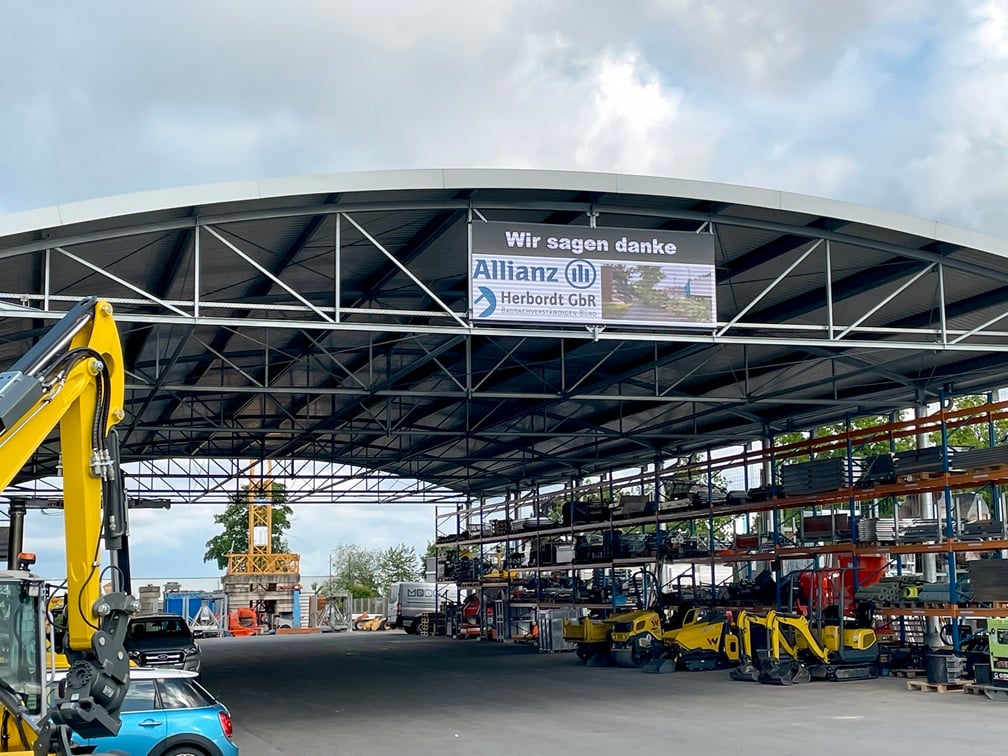
Jason Canney didn't want to just replace the old sign that was destroyed in the tornado with a copy. Instead, he invested his own money in a state-of-the-art LED display. When claims adjuster Kriegel arrives in Paderborn for the final meeting, the LED wall welcomes him with a special message: "Thank you, Allianz.”
"GenAI triggers a real revolution"
Lucie Bakker, Head of Claims at Allianz Versicherungs-AG, explains how artificial intelligence is enabling real-time claims settlement.
Ms. Bakker, you say that what excites you most about the insurance business is the "moment of truth. What do you mean by that?
The "moment of truth" is the critical moment when we can be there for our customers. And that is when they need us most: before, during and after a claim. This is where our strength lies. We have made enormous progress in claims settlement in recent years - especially after the flood of the century in the Ahr valley in 2021.
In what way?
For example, we have entered into a partnership with the Austrian weather data specialist UBIMET. Our customers with home, contents, or auto insurance now receive an SMS alert in the event of severe weather, with specific tips on how to prevent damage and protect their property. At the same time, we use UBIMET's AI forecasts to know exactly where and when a storm will hit. This allows us to send our mobile claims teams to the right places. During the floods in June 2024, our claims managers were on the ground the day the floods hit. After two weeks, all the damage had been assessed. We were really fast.
Over the next decade, many experienced claims managers will retire. Recruiting new talent will be a challenge. What does this mean for the future of claims within Allianz?
This means that we are specifically investing in digital solutions. Our goal is to continue to handle claims in-house. This is our core competence and the most important point of contact with our customers.
The Happy Path is a good example of a digital solution. It describes the ideal claims process - fast, smooth, customer-centric. To get there, we need three things: First, the data; second, we need to implement the best AI solutions on the market; and third, we need to take a fresh look at our processes and redesign them based on that. We call this "systems thinking”. We are trying to change the way we think to eliminate bureaucratic processes and implement simple, fast claims solutions - and create real customer excitement.
How does this work in practice?
In accident insurance, for example, the degree of disability needs to be determined. In the past, customers would send us their surgical and medical reports, as well as X-rays, for example after a cruciate ligament rupture. Then, about a year after the accident, they had to undergo another medical examination to determine their level of disability. Only then could we pay them. For a typical ski accident requiring surgery, the average processing time was two and a half years, with more than 45 touch points between the customer, sales and us. Through "systems thinking," we have found that experienced claims managers can often accurately assess the degree of disability based on medical records. This is where our AI models come in. Today, we have reduced the number of touchpoints from 45 to two and the processing time to two days. Our customers are thrilled.
How is AI impacting claims handling at Allianz?
Fundamental. GenAI is truly revolutionizing the insurance business. It allows us to process claims in real time. For example, if a customer calls to report a burst water pipe and wants to know if the claim is covered, our claims managers can respond immediately using GenAI. This is because the language model has read and understood all the relevant insurance terms and conditions in a matter of seconds. However, it will still be important for real people to make the final decisions and take responsibility - especially when it comes to the quality of the answers.
Further information
More news
About Allianz
The Allianz Group is one of the world’s leading insurers and asset managers, active in almost 70 countries and serving around 97 million private and corporate customers*. Our customers benefit from a broad range of personal and corporate insurance services, including property, life and health insurance, as well as assistance services, credit and global business insurance. Recognized for the seventh consecutive year as the number one global insurance brand in Interbrand’s Best Global Brands 2025 ranking, Allianz’s success is built on technology-enabled customer centricity – providing peace of mind, protection, and prevention for our customers and strengthening the resilience of individuals, communities, and societies. We are one of the world’s largest investors, managing around 791 billion euros** on behalf of our insurance customers. Furthermore, our asset managers PIMCO and Allianz Global Investors manage about 2.2 trillion euros** of third-party assets. Thanks to our systematic integration of environmental and social criteria in our business processes and investment decisions, Allianz received an MSCI ESG Rating of AAA (as of March 2026). In 2025, our 156,000 dedicated employees achieved a total business volume of 186.9 billion euros and an operating profit of 17.4 billion euros for our shareholders.
* As of December 31, 2025. Customer count reflects Allianz customers in consolidated entities that are part of the customer reporting scope only.
** As of June 30, 2026.
Cautionary note regarding forward-looking statements
As with all content published on this site, these statements are subject to our cautionary note regarding forward-looking statements: