
By Tobias Moorstedt, Nansen & Piccard

20 Years of Allianz Arena:
Honoring a Football Landmark
The seat area of an arena chair measures about 40 by 40 centimeters, 0.16 square meters per spectator. That’s comfortable – but honestly, it’s way too much. Because the longer the match goes on, the more often Michael Olise and Jamal Musiala sprint toward the opponent’s goal, the further forward you slide on your seat. You lean toward the pitch, perch on the edge, rock on your toes, your whole body tense, ready to leap up when the ball finally hits the net and 75,000 voices erupt in a single, thunderous roar: Yessssss!
The pull of the pitch isn’t just about the quality of the football, it’s built into the Allianz Arena itself: the revolutionary proximity to the field, the steep stands with an incline of up to 34 degrees, which, as one newspaper noted in 2005 with a mix of awe and anxiety, “pushes the limits of what’s legally allowed by building codes.” Our arena: almost illegally good. Any more intense and you’d need seatbelts.

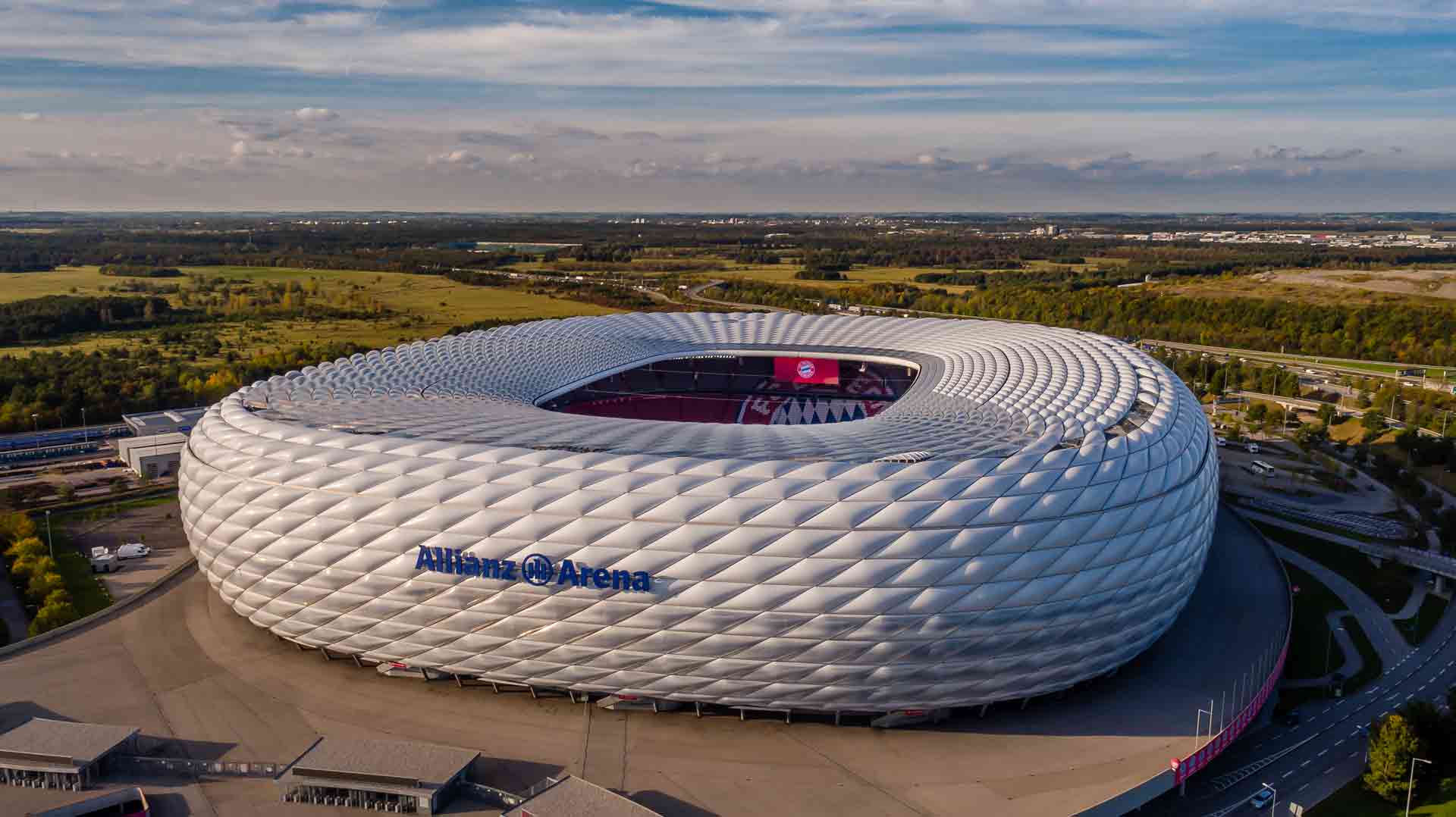
When FC Bayern first took to the pitch in the Allianz Arena 20 years ago, defeating the German national team 4:2, the football world was unanimous: this is the best stadium in the world. “Glorious” (The Guardian), “a work of art” (Die Welt), “What a temple” (Süddeutsche Zeitung). Even Berlin’s left-leaning Tageszeitung wrote that the stadium was “much more beautiful, much bolder, much more magnificent” than anyone would have expected from FC Bayern. Yet despite all the superlatives, no one could have predicted just how groundbreaking and influential this stadium would become. The Arena marked the dawn of modern football in Germany.
The 2000s saw football evolve in leaps and bounds – it became faster, more complex, more intense, more digital, more lucrative, more global. Our visionary high-tech arena was ahead of its time, part of a trend before it even existed – and it catapulted FC Bayern into new realms. But let’s start at the beginning.
Talk to Uli Hoeneß about the arena today and he’ll call it the most beautiful stadium in the world – but he’s quick to point out the historical context: “If Franz Beckenbauer hadn’t brought the World Cup to Germany, this arena wouldn’t exist.” Suddenly, the endless stadium debate in Munich was over, suddenly there was a site to build on. If the world was coming to visit, we needed a living room to match. Hoeneß admits he “couldn’t quite picture the red ring at first.” But because the decision-makers wisely chose the ingenious yet economical design by architects Jacques Herzog and Pierre de Meuron, the opening match of the 2006 World Cup was held at the Allianz Arena.
June 9, 2006, Germany vs. Costa Rica, 6:06 p.m.: Philipp Lahm dribbles past two defenders on the left edge of the box and curls the ball into the top right corner for 1-0. That goal was not just the start of the “summer fairytale,” but also the beginning of a new era that brought football into every corner of society – and the world. Many international Bayern fans say they fell in love with Schweinsteiger, Lahm – and the Arena – during that World Cup. And then with FC Bayern itself.

A Winning Streak from the Start
The very first official FC Bayern goal in the Arena: Owen Hargreaves, after a pass from Roque Santa Cruz. Final score against Mönchengladbach: 3-0. In fact, Franz Beckenbauer had already scored at the opening – with an oversized show ball into an empty net. FC Bayern immediately launched an impressive home streak in the Bundesliga, keeping five consecutive clean sheets and winning their first eleven home games. At the end of the Arena’s first season: the double, FC Bayern won both the national league (Bundesliga) and the national cup (DFB-Pokal).
On the pitch, football was still closer to its past: with crosses from deep and plenty of physicality. But in the second half of the 2000s, things began to shift – and the Allianz Arena became a laboratory for a new era. Suddenly, people were talking about passing dynamics, triangles, spatial control. In 2005, the Bundesliga also began using modern data tracking; Opta Sports recorded up to 2,000 events per match – heatmaps, running stats, passing accuracy. What used to be scribbled in a coach’s notebook was now discussed publicly, on TV shows, in fan pubs, and on social media. The evolution is clear in the data: in 2005, FC Bayern averaged 377 passes per game – six years later, it was over 600. And while Bayern averaged 18 penalty box actions per game in 2005/06, by 2013/14 it was more than double that.
The Allianz Arena provided the stage for this new football: under Louis van Gaal, Jupp Heynckes, and Pep Guardiola, FC Bayern played not only the most successful but also the most beautiful football in Europe. As if the innovative architecture had rubbed off on the playing style. The prerequisites: a perfect pitch, and the closeness to the fans, who inspired the players to great comebacks, unforgettable goals, and legendary victories that could only have happened here: the 4:0 against Barcelona in the 2013 Champions League semi-final, the dramatic 4:2 comeback against Juventus in 2016, the commanding 3:0 against Leverkusen just a few months ago… Yessssss!
The Moment of Release
Since 2005, football has become faster, more complex, more spectacular – and the Allianz Arena captures it all: with the spidercam under the roof, offering new perspectives; with Wi-Fi from day one, and since 2020 even 5G, so everyone can share their experiences with the world. The most important moment in a football stadium, wrote Nobel laureate Elias Canetti, is the moment of “discharge”: when everyone in the stands “sheds their differences and feels as one. For the sake of this happy moment, when no one is more or better than anyone else,” people go to the stadium.
And even fans watching at home can feel the Arena’s magic. That’s crucial, because the 2000s also marked the start of a new economic era in football. In 2005, the year the Arena opened, Chelsea FC became English champions for the first time in the Abramovich era. Driven by digitalization and globalization, Bundesliga TV revenues doubled between 2005 and 2012 to over 600 million euros per season (today, it’s 1.4 billion). With the Allianz Arena, FC Bayern managed to remain internationally competitive in the age of investor- and oligarch-owned clubs. In 2005, Bayern’s revenue was just under 200 million euros. In 2024, the club broke the billion-euro barrier for the first time. This was made possible in part by a stadium that is virtually always sold out for FC Bayern men’s matches and attracts three million people a year. Revenue from the Allianz Arena – merchandising, hospitality, events – has steadily increased since the opening, according to managing director Jürgen Muth. In addition to Bundesliga and Champions League games, the stadium now hosts corporate events, tours, NFL games, and soon, pop concerts. “The Allianz Arena has to work for the fans in the stands,” says stadium boss Jürgen Muth, “but also for visitors who want to enjoy the event.” A match lasts 90 minutes. But the Arena is open for six hours. Muth says: “There’s still so much potential.”
But it’s also important to note: the cheapest Bundesliga ticket costs just 15 euros (in the Premier League, comparable tickets for top teams are two to three times as expensive). An arena for everyone.
When the Allianz Arena opened its doors in 2005, architect Jacques Herzog said: “No football stadium has ever been so thoroughly thought through.” When you push open the heavy iron doors, you walk through functional concrete corridors that lead you straight to the heart of it all: the pitch. Shops and kiosks are built into the concrete pillars, with simple signage above: “Beer,” “Bratwurst,” “Popcorn.” Nothing distracts you – and nothing leads you astray. And the design works. You notice it the moment you glance away from the pitch during a match and catch sight of the Munich evening sky – a small shock, a reminder that there’s still a world outside. While other clubs build multi-purpose arenas with hotels, cinemas, and flagship stores, FC Bayern believes there’s nothing more exciting than the “beautiful game.”
The killer feature of the Allianz Arena: it’s both a visual marvel and a cauldron of noise. It works for fans in the stadium, who lose themselves in the game and the crowd, and for viewers at home, who experience the pulsating, bouncing “Südkurve” (the southern stand of the Allianz Arena, home to the club’s most passionate supporters) – along with panoramic shots that celebrate the arena’s shape and color and prove: yes, it really exists. The Allianz Arena always looks spectacular, no matter the angle. Back in 2005, the ADAC warned drivers on the A9 about the stadium’s dazzling lights. There were fears it would distract motorists like the Northern Lights or some other natural phenomenon. Twenty years on, there’s no evidence of increased accidents. But anyone driving south and passing the Arena knows: finally, Munich. Finally, home.
In 2025, when you walk across the esplanade toward the Allianz Arena or climb the stairs to the upper tier, you don’t feel like you’re entering a 20-year-old building. “You have to give huge credit to our people who look after the stadium,” says Uli Hoeneß. “Thanks to them, the Allianz Arena looks as if it opened yesterday.” Arena boss Jürgen Muth returns the compliment to the club: “With FC Bayern as our partner, we have the resources to stay at the cutting edge. Because standing still means falling behind.” The Arena is built on the principle of constant evolution: in the last 20 years, not only has capacity been repeatedly increased, but the video screen area has more than doubled; and the number of colors that can be displayed on the famous façade has risen from three to 16 million (see infographic).

This Infograpic is only available in German.
The Arena’s ingenious yet simple building plan and the vision of those in charge ensure the stadium will always be state-of-the-art. FC Bayern will still be playing in the Allianz Arena in 20, 40, even 100 years. Maybe in the distant future, the façade will show a live feed of the match, maybe fans will arrive by air taxi (or beamed directly from Marienplatz). But one thing is certain: when the ball rolls in the red ring and on the green rectangle, and the heirs of Olise and Musiala charge toward the opponent’s goal, nothing will keep us in our seats.
This text appeared in the May edition of FC Bayern’s members’ magazine “51”.
Further information
More news

.jpeg)


About Allianz
Last updated: September 23, 2026
The Allianz Group is one of the world’s leading insurers and asset managers, active in almost 70 countries and serving around 97 million private and corporate customers*. Our customers benefit from a broad range of personal and corporate insurance services, including property, life and health insurance, as well as assistance services, credit and global business insurance. Recognized for the seventh consecutive year as the number one global insurance brand in Interbrand’s Best Global Brands 2025 ranking, Allianz’s success is built on technology-enabled customer centricity – providing peace of mind, protection, and prevention for our customers and strengthening the resilience of individuals, communities, and societies. We are one of the world’s largest investors, managing around 791 billion euros** on behalf of our insurance customers. Furthermore, our asset managers PIMCO and Allianz Global Investors manage about 2.2 trillion euros** of third-party assets. Thanks to our systematic integration of environmental and social criteria in our business processes and investment decisions, Allianz received an MSCI ESG Rating of AAA (as of March 2026). In 2025, our 156,000 dedicated employees achieved a total business volume of 186.9 billion euros and an operating profit of 17.4 billion euros for our shareholders.
* As of December 31, 2025. Customer count reflects Allianz customers in consolidated entities that are part of the customer reporting scope only.
** As of June 30, 2026.
Cautionary note regarding forward-looking statements
As with all content published on this site, these statements are subject to our cautionary note regarding forward-looking statements: