Last updated: September 23, 2026

Power of Unity
Polarisation can be reversed
When the coalition government of the Social Democratic Party (SPD), the Free Democratic Party (FDP) and the Greens fell apart, the concerns of Robert Habeck, the minister for economic affairs, went beyond the question of future political majorities: “This is about a much more profound challenge for our democracy. We first have to reopen the political space. We have to listen, talk and seek solutions.”
Attention to and openness for the position of the other side, the art of debate, the objective struggle for compromise are under pressure not only in this country. Many societies are deeply divided, and populism and extremism are threatening social cohesion worldwide.
Allianz Research uses twelve indicators to measure the economic and social resilience of national economies on an annual basis with the Social Resilience Index. Although the overall index has improved slightly compared to the previous year, polarization has increased in 17 EU countries. Despite the stabilization of the global economy, unrest has also increased in other regions, particularly in the Middle East (+40.3 %) and Africa (+19 %).
Polarization is a social phenomenon that influences the perception of technological progress, debates on diversity and equality, and the role of the media. Polarization also causes measurable economic damage because the business climate and consumer spending suffer – or, more specifically, protests, uprisings, or riots cause millions of dollars in property damage.
These are disturbing developments that companies can no longer afford to ignore – if only in their own self-interest with regard to their own business base. But also because, according to the Edelman Trust Barometer, companies are currently considered the most trusted institution – compared to the media, NGOs and governments. For employees, for customers, for business partners. They should use their position in the face of the situation and play a stronger role in bridging differences.
Allianz is one of the largest financial services providers in the world and operates in over 70 markets globally. In an increasing number of these markets, civil society is deeply divided. We no longer want to accept this. As a company with a 134-year history, whose values are based on the principles of free and open societies, and that exists to protect what people care about most, we are already involved in numerous initiatives and partnerships for social causes such as education or exercise. Now we are going one step further: with a new initiative called “Power of Unity”, we want to counter the growing crisis of trust that is undermining the foundations of social cohesion, optimism for the future and economic prosperity.
The global initiative aims to empower and unite individuals and organizations in the face of increasing polarization worldwide. Through research, thought leadership, learning programs, listening sessions and gatherings, the multi-year campaign is designed to help foster dialogue and respectful debate, create a better understanding of the complexities of business and politics, and restore trust between individuals, institutions and governments.
In line with the “Walk the Talk” principle, we start with ourselves: As an employer of over 150,000 people worldwide, we want to support our own employees in overcoming their insecurities and fears, which are often at the root of divisive positions and attitudes. As a CHRO, I regularly take part in dialogues with employees and focus primarily on listening. It is simply a matter of understanding and addressing the causes of polarization – fears and uncertainties.
We also support our employees with a wide range of learning and development opportunities, for example, to recognize fake news in social media, to strengthen their own mental resilience in times of uncertainty and to practice appreciative, constructive communication. We want to inspire and motivate everyone who is interested to think about how social polarization can be overcome and what contribution each individual can make, with personalities and contemporary witnesses from politics, sports or culture, from Harry Kane to Sigmar Gabriel or Margot Friedländer. Our employees have responded very well to these offers and report “goosebump moments” or important impulses for both their daily work and their lives outside of work. With all employees, customers, business partners or every supporter in spirit, we want to build a broad united front against polarization and strengthen cohesion and a sense of belonging, in line with our name Allianz.
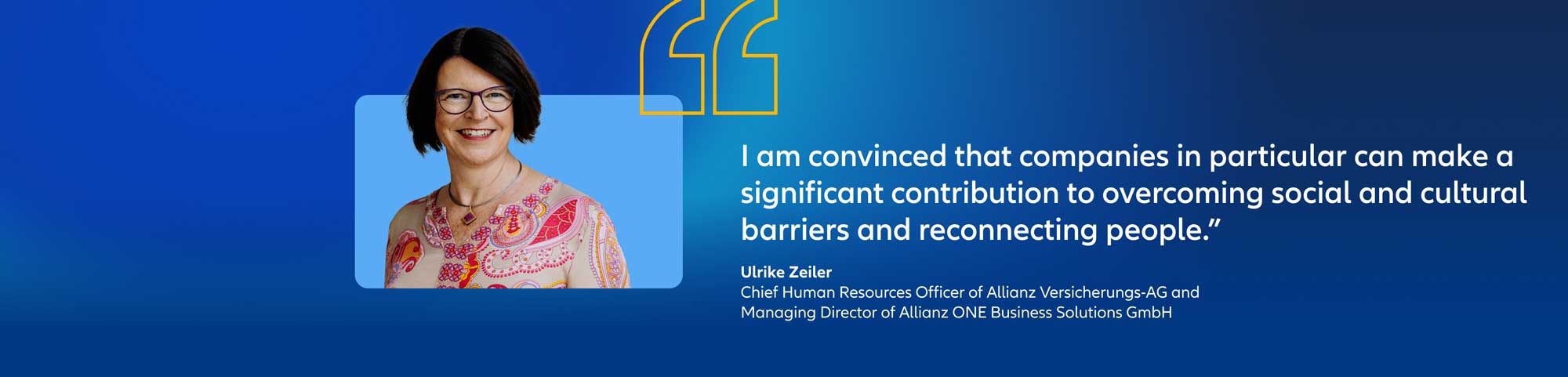
I am convinced that companies in particular can make a significant contribution to overcoming social and cultural barriers and reconnecting people. After all, isn't it true that different opinions, an open culture and diverse backgrounds are what make us truly productive and innovative? These values are indispensable for Germany as a business location and a basis for success for all internationally operating companies. But this also means that companies must create a working atmosphere in which a diverse workforce feels comfortable and pluralism of opinions functions in a lively way on a small scale. Employees who share different perspectives and experiences and can exchange ideas in open forums that are safe, where “speak-up” does not create disadvantages, and who experience that different approaches and points of view are valued in their organization, are committed to their cause with heart and mind. This motivation is also felt by customers.
New optimism: polarization can be reversed
Even if it doesn't look like it right now, the division of our society does not have to continue. Democracies have repeatedly succeeded in reducing polarization in their country and uniting citizens in a shared confidence in the future. Not only politicians, but also decision-makers in companies should make their contribution and work hard for a united workforce, electorate and citizenry. With climate change, rising living costs, shrinking economies and enormous geopolitical tensions, we have many challenges to overcome – and we can only do so together.
Unlock more insights!
Explore more global and local initiatives at the Power of Unity hub
Explore more global and local initiatives at the Power of Unity hub
About Allianz
The Allianz Group is one of the world’s leading insurers and asset managers, active in almost 70 countries and serving around 97 million private and corporate customers*. Our customers benefit from a broad range of personal and corporate insurance services, including property, life and health insurance, as well as assistance services, credit and global business insurance. Recognized for the seventh consecutive year as the number one global insurance brand in Interbrand’s Best Global Brands 2025 ranking, Allianz’s success is built on technology-enabled customer centricity – providing peace of mind, protection, and prevention for our customers and strengthening the resilience of individuals, communities, and societies. We are one of the world’s largest investors, managing around 791 billion euros** on behalf of our insurance customers. Furthermore, our asset managers PIMCO and Allianz Global Investors manage about 2.2 trillion euros** of third-party assets. Thanks to our systematic integration of environmental and social criteria in our business processes and investment decisions, Allianz received an MSCI ESG Rating of AAA (as of March 2026). In 2025, our 156,000 dedicated employees achieved a total business volume of 186.9 billion euros and an operating profit of 17.4 billion euros for our shareholders.
* As of December 31, 2025. Customer count reflects Allianz customers in consolidated entities that are part of the customer reporting scope only.
** As of June 30, 2026.
Cautionary note regarding forward-looking statements
As with all content published on this site, these statements are subject to our cautionary note regarding forward-looking statements: