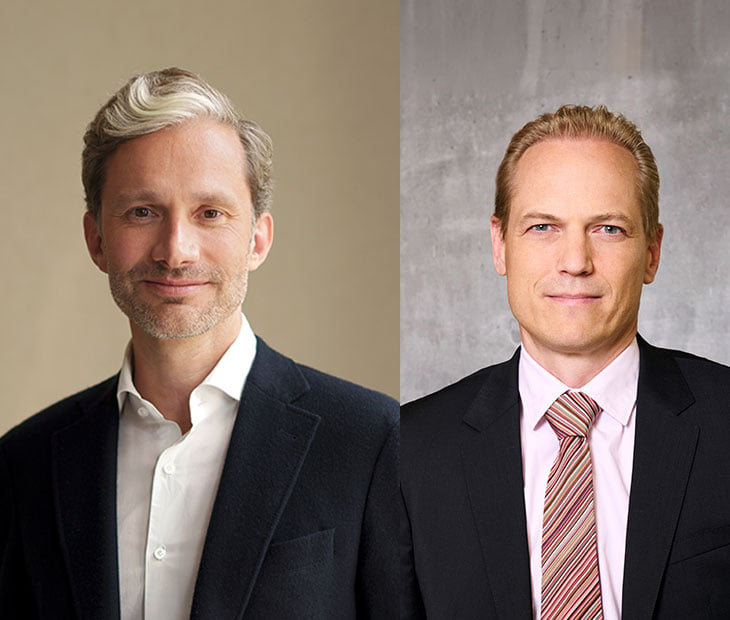
On the occasion of the Olympic Winter Games Milano Cortina 2026, the German Bobsleigh and Sled Association (BSD) together with experts from the Allianz Center for Technology (AZT) presented the latest ideas and research findings for improving safety for bobsleigh athletes to the media in Cortina d'Ampezzo on February 11, 2026. The focus was on the Allianz Safety Sled with the new HIP (Head Impact Protection) system to prevent head injuries to athletes, and the PASS (Passive Athlete Safety System) belt system to secure the brakeman and second pusher in the bobsled.
Media Release in cooperation with the German Bobsleigh and Sled Association (BSD)
Greater safety in bobsleigh: ducking your head and holding on tight is not enough
Quantum leap for safety in bobsleigh
“Bobsleigh is the Formula 1 of winter sports, and as the fastest winter sport, the dangers remain very real. While successful work has been done on the safety of the tracks in recent years, we will significantly increase the safety of athletes in bobsleigh in the future with the HIP and PASS systems,” said Thomas Schwab, CEO of the BSD. “Both solutions represent a quantum leap for safety in bobsleigh. We developed them together with the Allianz Center for Technology (AZT). The systems are part of a holistic safety concept. This includes head protection, preventing athletes from being thrown out of the sled after a crash, and improving protective clothing.”
What happens next?
The two concepts will be discussed with the sports and equipment commissions of the International Bobsleigh & Skeleton Federation (IBSF) in the near future. It is important that the solutions presented are designed in collaboration with experts and sports equipment manufacturers in such a way that they can be easily and smoothly retrofitted to different bobsled models. “The goal would be to have both systems in use by mid-2028 at the latest,” said Thomas Schwab.
Safety of athletes in bobsleds after a crash
As part of the project, the Allianz Center for Technology (AZT), supported by the Technical University of Munich (TUM), conducted an analysis of the individual positions in the bobsled. This showed that the two front athletes are primarily at risk of hitting their heads. The two rear athletes are at high risk of being thrown out of the bobsleigh in the event of a crash.
HIP system for better head protection
Similar to a convertible, where the windshield frame and rear roll bar create a safety zone without a roof structure, the open design of the bobsled requires a front and rear structure that can keep forces away from the athletes. The new safety cell in the bobsled is designed to prevent direct impact to the occupants. The head is particularly at risk, as it cannot be adequately protected in the event of a crash. To this end, the HIP (Head Impact Protection) system was developed for the front of the sled to directly protect the driver's head. In a further step, this protection will be extended to the pushers by means of raised push bars at the rear, creating more safe space for all occupants.
“For head protection, it was crucial that structural integration into existing bobsleds was easy to achieve in order to ensure feasibility for all international teams. Therefore, a largely standardizable design had to be found. In addition, the athletes' mobility must not be impeded during the time-critical entry into the bobsled,” said Christian Sahr, Head of the Allianz Center for Technology (AZT).
This development work is being carried out by the Institute for Research and Development of Sports Equipment (FES) in Berlin, which traditionally manufactures the bobsleds for the BSD and is therefore ideally placed to contribute its knowledge of the structural requirements of bobsleds.
PASS belt systems protect athletes in positions 3 and 4.
Position 4 in the bobsled is particularly at risk in the event of a crash due to its unfavorable body posture under these atypical loads. The holistic safety concept of the BSD and Allianz therefore stipulates that the two rear athletes in the sled should be secured as a priority. The occupant restraint system for this was developed at the AZT. The most vulnerable position in the event of a crash is position 4 in the bobsled, the brakeman. He is in a vulnerable situation because he can only hold on to something very far away from his center of gravity. This means that he can be lifted out of the bobsled in the event of a crash. To prevent this, a restraint system close to the center of gravity is necessary.
"We were able to test a few concepts with the bobsled team Illmann at the Altenberg ice track. A belt system proved to be the best solution for the brakeman, in which the athlete jumps into an already open belt loop that then automatically wraps around his pelvis. In the event of a crash, the athlete can thus be held in the sled. This prevents contact with the ice and associated injuries, such as to the spine, or even burns caused by rubbing against the ice at high speed," said Markus Beischl, Engineer for Sports Equipment and Materials at the Allianz Center for Technology (AZT).
"We have tested a system in which the brakeman does not have to do anything and the belt fastens itself without any intervention. The brakeman does not have to actively fasten his seatbelt or change his sitting position. The variant can be easily built into any sled, does not interfere with the normal start procedure at all, and offers the safety of keeping the brakeman in position in the event of a crash," said bobsleigh pilot Maximilian Illmann.
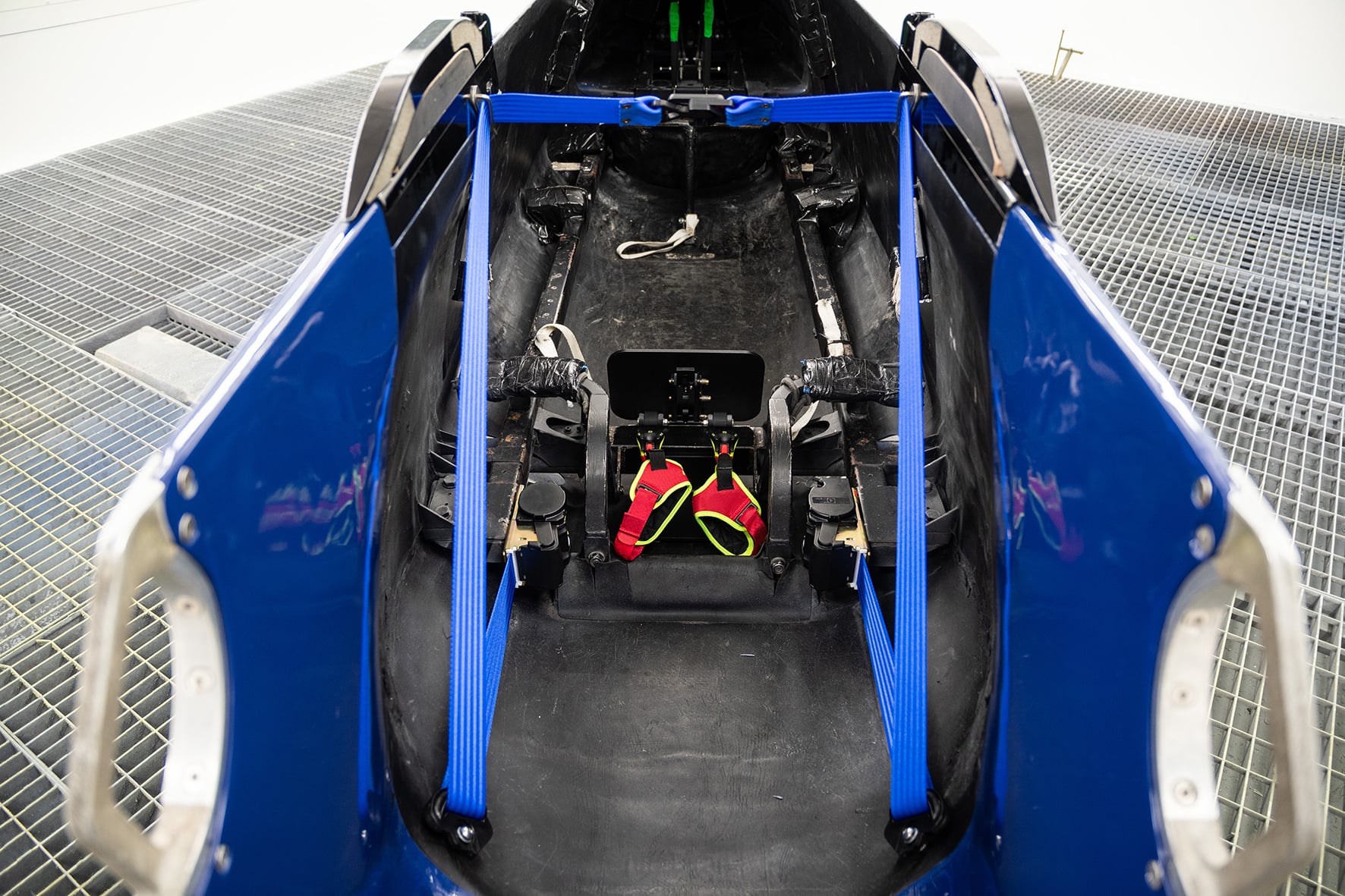
Furthermore, tests are currently being carried out to determine whether and how an additional wrist restraint can keep the brakeman's upper body inside the safety cell in the event of unconsciousness.
Securing the athlete in position 3 is more challenging due to the limited space available. Here, the AZT has developed a coupling system using a belt worn around the pelvis that attaches to an automatic locking system fixed to the chassis structure behind the athlete. The concept is currently being tested with active athletes.
The athlete in position 2 is protected by the HIP system and, due to their seating position, has a very low risk of being thrown out of the sled.
The pilot is adequately secured against falling out of the sled due to their seating position.
Allianz is the official insurer of the Olympic and Paralympic Movement
Through its partnership with the German Bobsleigh and Sled Association, Allianz is expanding its commitment to elite and popular sports. Allianz is a strategic partner of the Olympic and Paralympic Movement and has contributed to the successful organization of Paris 2024. Allianz will also be closely involved with the Olympic Winter Games Milano Cortina 2026 For many years, it has also been a partner of FC Bayern and a sponsor of the club's men's and women's teams. In addition to these global partnerships, Allianz supports numerous local clubs in Germany, from Alba Berlin Women's Basketball to the Mannheim Hockey Club. The focus is particularly on working with children and young people. Allianz also promotes sport and exercise among young people through the MoveNow initiative.
Related links
Further information
BSD contact:
Allianz contact:
About Allianz
Last updated: September 23, 2026
The Allianz Group is one of the world’s leading insurers and asset managers, active in almost 70 countries and serving around 97 million private and corporate customers*. Our customers benefit from a broad range of personal and corporate insurance services, including property, life and health insurance, as well as assistance services, credit and global business insurance. Recognized for the seventh consecutive year as the number one global insurance brand in Interbrand’s Best Global Brands 2025 ranking, Allianz’s success is built on technology-enabled customer centricity – providing peace of mind, protection, and prevention for our customers and strengthening the resilience of individuals, communities, and societies. We are one of the world’s largest investors, managing around 791 billion euros** on behalf of our insurance customers. Furthermore, our asset managers PIMCO and Allianz Global Investors manage about 2.2 trillion euros** of third-party assets. Thanks to our systematic integration of environmental and social criteria in our business processes and investment decisions, Allianz received an MSCI ESG Rating of AAA (as of March 2026). In 2025, our 156,000 dedicated employees achieved a total business volume of 186.9 billion euros and an operating profit of 17.4 billion euros for our shareholders.
* As of December 31, 2025. Customer count reflects Allianz customers in consolidated entities that are part of the customer reporting scope only.
** As of June 30, 2026.
Cautionary note regarding forward-looking statements
As with all content published on this site, these statements are subject to our cautionary note regarding forward-looking statements:
.jpeg)