Allianz Motor Day 2026

Allianz research links distraction to one in three road accidents

Distraction is one of the major risks in road traffic. However, its true impact on road safety has remained difficult to quantify. In an extensive research program for the Allianz Motor Day 2026, the Allianz Center for Technology (AZT) indicates that distraction is far more prevalent than accident statistics suggest: Distraction is a factor in one in three road crashes, either as the immediate trigger of a collision or as a contributing cause. 

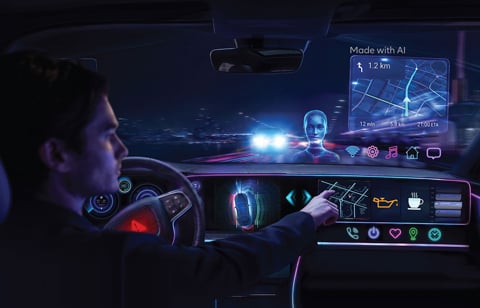
The significantly expanded range of features in modern vehicles makes it necessary to control certain functions via the touchscreen. At the same time, functions that used to be operated intuitively and without taking one’s eyes off the road are increasingly being moved to digital menus. For frequently used functions—such as controlling the air conditioning or the radio—often multiple taps are required today. As a result, drivers take their eyes off the road for longer periods of time and more frequently, both of which can compromise driving safety. The findings are published in the report “SWIPE. TAP. CRASH. Driver distraction in the digital car.”

"Our research shows that the same task can require up to 25 percent less visual attention in one vehicle than in another. That tells us something important: distraction is not just a question of driver behavior. It is also a question of design. A car is not a smartphone. When safety is at stake, function must come before design” said Dr. Klaus-Peter Röhler, Member of the Board of Management of Allianz SE, Insurance German Speaking Countries, Central Europe, Global Property & Casualty. His keynote at the Allianz Motor Day 2026 is available here.

Real-world driving studies conducted as part of the research program show that the design of the vehicle’s touchscreen interface has a significant impact on how long drivers take their eyes off the road while operating it. In tests comparing current vehicles, the same everyday tasks drew drivers’ eyes from the road for significantly different lengths of time, highlighting the impact of cockpit layout on driver attention: Depending on the task and cockpit concept, total off-road glance time differed by up to 25 percent — around three seconds for identical tasks.

“To ensure safe vehicle operation, clear recommendations are needed on which functions should be controlled via physical switches and which via touchscreen. At the same time, scientific insights into human-machine interaction should be applied consistently to design touchscreen interfaces that distract drivers as little as possible from the road” said Dr. Christian Sahr, Managing Director of the Allianz Center for Technology (AZT). 

A review of more than 80 published studies shows that particularly long off-road glances of more than two seconds are associated with a substantially increased crash risk. Every strand of the research, including the cognitive modelling set out below, points the same way: the problem is not the touchscreen per se, but how safety-critical functions are integrated into the cockpit.

To assess how distraction affects driver performance in critical situations, Allianz and cognitive modelling firm CogniBIT simulated four traffic scenarios using a cognitive driver model based on real-world glance data from the vehicle study:

  • In the motorway emergency-braking scenario, the share of runs ending in a collision rose from 18.2 percent for attentive drivers to 54.3 percent for distracted ones.
  • When a child suddenly ran into the road, it rose from 3.9 percent to 11.2 percent. And in 39 percent of those cases the distracted driver did not react at all.
  • Most notably, in all of the four simulated scenarios which you can read about in the Allianz report, distracted drivers perform worse than drivers simulated with a blood alcohol level of 0.8 per mille.
The findings also align with what drivers themselves already sense. Across nine countries (Australia, Austria, Brazil, France, Germany, Italy, Spain, Switzerland and the UK), 79 percent believe in-car technology has made distraction worse in recent years, and 53 percent rate the risk of distraction in general as high or very high. Of those who were responsible for an accident in the past three years, 73 percent say distraction definitely or possibly played a role. When it comes to safety-critical functions, 65 percent of drivers across all surveyed countries prefer physical controls over touchscreen menus.

Allianz sets out three fronts for reducing distraction in the digital car:

  1. Manufacturers: For safety-critical and frequently used controls, design must follow function. Manufacturers must design cockpits around real-world driving conditions. Safety-critical functions such as windscreen wipers, indicators, dipped and main-beam headlights, hazard warning lights, defrosting and demisting must be quick and intuitive to reach. Controls should remain permanently accessible, either through physical controls or clearly defined, permanently available touchscreen areas. This reduces search time, keeps drivers' eyes on the road and makes it easier to operate unfamiliar vehicles. In Europe, Euro NCAP is already rewarding designs that provide direct access to key functions rather than hiding them in menus.
  2. Regulators and enforcement bodies should treat distraction systematically, starting with consistent recording. Effective regulation, enforcement and distraction-monitoring technologies can help deter risky behavior, improve understanding of the problem and reduce distraction-related crashes. As vehicles become increasingly digital, regulatory frameworks and enforcement measures must evolve to address new sources of distraction.
  3. Driver attention remains the decisive safety factor. Across countries, 86 percent of drivers say that the main responsibility for reducing distraction lies with them. While driver assistance systems can support attention, it cannot replace it. Nonetheless, greater awareness of the risks of distraction is needed through public-awareness campaigns, driver education and clearer in-car warnings.
The Allianz Center for Technology (AZT) conducted its most comprehensive research program on driver distraction to date. It analyzed more than 34,000 crash cases, ran eye-tracking studies in real vehicles and carried out a driving simulator study with the Technical University of Munich. The program also included cognitive modelling of critical traffic situations, an international driver survey and a review of more than 80 published studies. The findings were presented at the 14th Allianz Motor Day and are published in the report “SWIPE. TAP. CRASH. Driver distraction in the digital car.”
Christina Bersick
Allianz Deutschland AG
Heidi Polke
Allianz SE
Katryna Nolan
Allianz SE

Last updated: September 23, 2026

The Allianz Group is one of the world’s leading insurers and asset managers, active in almost 70 countries and serving around 97 million private and corporate customers*. Our customers benefit from a broad range of personal and corporate insurance services, including property, life and health insurance, as well as assistance services, credit and global business insurance. Recognized for the seventh consecutive year as the number one global insurance brand in Interbrand’s Best Global Brands 2025 ranking, Allianz’s success is built on technology-enabled customer centricity – providing peace of mind, protection, and prevention for our customers and strengthening the resilience of individuals, communities, and societies. We are one of the world’s largest investors, managing around 791 billion euros** on behalf of our insurance customers. Furthermore, our asset managers PIMCO and Allianz Global Investors manage about 2.2 trillion euros** of third-party assets. Thanks to our systematic integration of environmental and social criteria in our business processes and investment decisions, Allianz received an MSCI ESG Rating of AAA (as of March 2026). In 2025, our 156,000 dedicated employees achieved a total business volume of 186.9 billion euros and an operating profit of 17.4 billion euros for our shareholders.

* As of December 31, 2025. Customer count reflects Allianz customers in consolidated entities that are part of the customer reporting scope only.

** As of June 30, 2026.

As with all content published on this site, these statements are subject to our cautionary note regarding forward-looking statements:
Choose an element

Choose an element

Choose an element

Choose an element

Choose an element

670 results

Oct 21, 2026 | Mobility, Reports & studies, Property & Casualty

Content Report: Swipe. Tap. Crash. Driver distraction in the digital car

The Allianz Motor Day 2026 report examines how touchscreens, smartphones and digital cockpits affect driver attention, crash risk and road safety.

Oct 21, 2026 | Media release, Property & Casualty, Mobility

Allianz research links distraction to one in three road accidents

New Allianz research finds distraction is a factor in one in three road crashes and highlights how digital cockpit design can impact driver attention and safety.

Oct 21, 2026 | Article, Mobility, Property & Casualty

Driver distraction in the digital car and its implications for road safety

In this keynote from the 14th Allianz Motor Day, Klaus-Peter Röhler examines the growing risks of driver distraction, the role of in-car screens, and the actions needed to improve road safety.

Oct 16, 2026 | Media release, Strategy & Investments, Asset Management

How Germany’s investment gap could be its biggest opportunity

Germany faces an investment gap of up to EUR730bn. Allianz Research explains how reforms and private capital could help unlock sustainable growth.

Oct 16, 2026 | Strategy & Investments, Statement, Asset Management

From underinvestment into a powerful new growth cycle

Germany faces an investment gap of up to EUR730bn. Allianz SE Board Member Andreas Wimmer explains how reforms could unlock investment and growth.

670 results