



Last updated: September 23, 2026

Allianz Motor Day International Mobility Summit 2026
“Driver distraction in the digital car and its implications for road safety”

Ladies and gentlemen, welcome to the Allianz Motor Day 2026.
Distraction at the wheel is nothing new. In 2011, we first highlighted how everyday distraction, from phones and smoking to children in the back seat, influenced drivers.
More than a decade on, society takes distraction more seriously, yet the problem persists. According to the latest WHO figures, around 1.16 million people died in 2025 as a result of road traffic crashes — and, it is unclear how many deaths are caused by distraction, since the official numbers, as we will see, capture only a fraction of the distraction problem.
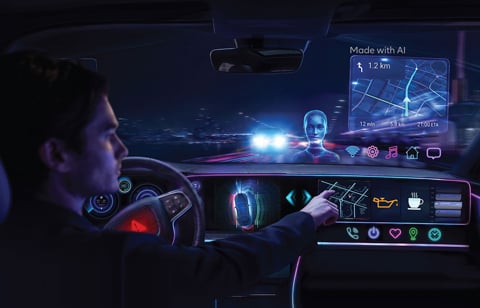
The nature of distraction has also changed. In 2011, it was something drivers brought into the car. Today, it is increasingly built in. In 2022, the AZT flagged in-car touchscreens as an emerging risk. Drivers can now swipe and tap almost constantly when their eyes belong on the road.
Today’s cars are more connected and intelligent than ever. But as the cockpit becomes a screen, it competes with the road for the driver's attention.
Ladies and gentlemen, let me say this clearly: A car is not a smartphone. When safety is at stake, function must come before design.
That is why the 14th Allianz Motor Day focuses on distraction – and above all from cockpit design. If we are serious about Vision Zero —eliminating all deaths and serious injuries on the road — then design is critical.
I will address this from four angles:
- What do modern cockpits demand of drivers?
- Why is distraction so hard to measure?
- What does our research reveal?
- And how can manufacturers, regulators and drivers reduce the risk?
What modern cockpits demand of drivers
Sit in any new car and the touchscreen is unmissable. Displays dominate, and many physical controls are now touch-based surfaces, where reaching one function can take several taps.
That works on a smartphone. But in a car, safety-critical controls — indicators, windscreen wipers, hazard warning lights, defrost and demisting — must remain easy to find and operate. Every second spent searching is a second with eyes off the road.
Now, screens bring benefits from navigation to rear-view cameras. The problem is not the screen, but the lack of clear thinking about which functions belong there and how they are designed.
Why distraction is hard to measure
In insurance, we see the consequences every day, and behind every accident or damage file, there is a human story. Yet distraction's role has been hard to measure. It rarely leaves a trace an investigator can assess with certainty.
To understand its true scale, the AZT began with a clear hypothesis: that official records significantly understate how often distraction is involved in accidents.
We tested it through a broad research program. It included analyses of official German accident statistics and more than 34,000 cases from the German In-Depth Accident Study database (GIDAS), as well as real-vehicle eye-tracking, cognitive modeling, and an international consumer survey. We also conducted a driving-simulator study with the Technical University of Munich.
Based on all of our research, we conclude that distraction contributes to one in three road crashes. It may not always be the sole cause — or leave a trace in the official record. But it is often the decisive factor that turns an everyday driving situation into a critical one, and a critical situation into a crash.
One in three accidents linked to distraction is our overall conclusion. It draws on multiple research methods and datasets, each shedding light on a different aspect of distraction. Among the many insights we gained from our research, three other findings stand out.
Three critical research findings
First, behavior.
Our survey confirmed what most drivers sense: distraction is not unusual. As an average across nine countries, nearly one in five drivers have caused or shared blame for a crash in the last three years. Of them, 73% say distraction “definitely” or “possibly” played a part. What evidence cannot always prove, the drivers themselves admit.
Ask drivers about screens, and four in ten admit to having a critical moment when using one. Two in three want classic controls back for key functions — and this is no older-driver nostalgia: among 18-to-25-year-olds, it rises to 72%.
Second, design.
Using eye-tracking, we timed how long drivers looked away during everyday touchscreen tasks such as entering a destination or choosing a song.
When performing the same task in two vehicles with differing cockpit design, glance-away time varied by up to 25%, around three seconds. At 50km per hour, that is more than 40 meters travelled in three seconds. This time gap can be the difference between staying in control and a crash. Design matters.
Third, impact of distraction on accident risk.
Together with cognitive AI technology firm Cognibit, we simulated four different driving scenarios. This enabled us, for the first time, to demonstrate the impact of distraction on accident risk.
In our simulations, distracted drivers drifted out of their lane, struggled with tricky maneuvers and braked too late. When the car ahead stopped suddenly on the motorway, or a child ran into the road, their risk of crashing nearly tripled.
The most striking result: distracted drivers did worse than those simulated with a blood alcohol level of 0.8 per mille in all four scenarios. On a country road, they crossed into oncoming traffic about one time in twenty. Attentive drivers never did — and neither did drunk drivers.
The pattern is clear: risk does not climb steadily. It holds steady, then spikes. Earlier research pins down the threshold: a glance longer than two seconds sharply raises the risk of a crash or near-crash.
Three fronts for change
To mitigate distraction risks, we call for action on three fronts: from the manufacturers who build the cockpit, the regulators who set the rules and the drivers behind the wheel.
First, manufacturers.
Manufacturers must design cockpits around the reality of driving. Safety-critical functions — windscreen wipers, indicators, dipped and main beam headlight, hazard warning lights, defrosting and demisting — must be quick and intuitive to reach.
That does not always mean more buttons. It means physical controls or dedicated touchscreen areas that remain permanently accessible and provide clear haptic feedback.
Euro NCAP, Europe’s vehicle safety rating body, is acting on this. From 2026, its ratings reward cars that keep core functions as physical controls or immediate one-touch buttons, rather than burying them in menus. Placing controls where drivers expect them cuts searching and also eases switching between cars.
And manufacturers are responding. From its next generation, a large German OEM will include volume, heating on each side, fans and hazard lights as real buttons as a standard, positioned below the screen.
Others, like an Italian carmaker, are rebalancing digital and physical controls. And if anyone knows the value of a second of attention, it is the maker of a car that reaches 300 kilometers per hour.
This is not a step backward. Nor is it screens versus buttons. Balance — not the absence of screens — is the path to a safer future.
Second, lawmakers, regulators and enforcement.
Distraction must be treated systematically, starting with recording. We cannot manage a risk we do not measure. Police need access to the data and the means to record it consistently.
We support the recommendations of the 64th German Traffic Court Conference presented in Goslar this January. Because distraction is so hard to prove — and therefore to prosecute — the conference called for a nationwide legal basis for automated monitoring, using AI-assisted "phone-detection" cameras and tougher penalties.
It also called for a clear legal definition of the "brief glance." Section 23 of the German Road Traffic Act allows a short look at a device, but it does not define it. To this, Allianz would add better research into distraction-related accidents and stronger awareness campaigns.
The car itself is being enlisted too — but here the gap is timing, not law. Since July 2026, new cars in Europe must have an advanced driver-distraction warning system that monitors the driver’s visual attention and warns when the eyes leave the road for too long.
That is progress. Yet these systems typically intervene only after about 3.5 seconds above 50 kilometres per hour, and after up to 6 seconds at lower speeds. But by that point, the risk has already climbed sharply. We need warning thresholds that are tailored to the specific situation and environment – warnings that are issued when the risk increases.
Third, drivers.
Why is, for example, using a phone while driving still socially accepted? And how is tapping on a cockpit screen any different? We need more effective campaigns to build new social norms. Distraction is not a minor offense — it kills.
Drivers accept a large share of responsibility: across countries, 86% say the main responsibility for reducing distraction is theirs. But responsibility is shared — across drivers, manufacturers, and regulators. As our survey shows, drivers recognize this too, calling for higher fines and limits on complex controls while driving. Technology can support safe driving, but it cannot replace attention.
Safer, not just smarter
To conclude, the future of mobility will be digital, connected and increasingly automated. That holds real promise for safety. But technology must serve safety, not compete for the driver’s attention.
The screens in today's cars are extraordinary. But let me say again: A car is not a smartphone.
A car moves through public space and carries responsibility. Every screen, every menu, every control must answer one question: Does it help the driver stay in control, and everyone around them stay safe?
At Allianz, we believe mobility's next chapter must be smarter — and safer. As cars become more digital, interface design is no longer a question of style. For safety-critical controls, design must follow function.
Thank you.
Further information
More news
About Allianz
The Allianz Group is one of the world’s leading insurers and asset managers, active in almost 70 countries and serving around 97 million private and corporate customers*. Our customers benefit from a broad range of personal and corporate insurance services, including property, life and health insurance, as well as assistance services, credit and global business insurance. Recognized for the seventh consecutive year as the number one global insurance brand in Interbrand’s Best Global Brands 2025 ranking, Allianz’s success is built on technology-enabled customer centricity – providing peace of mind, protection, and prevention for our customers and strengthening the resilience of individuals, communities, and societies. We are one of the world’s largest investors, managing around 791 billion euros** on behalf of our insurance customers. Furthermore, our asset managers PIMCO and Allianz Global Investors manage about 2.2 trillion euros** of third-party assets. Thanks to our systematic integration of environmental and social criteria in our business processes and investment decisions, Allianz received an MSCI ESG Rating of AAA (as of March 2026). In 2025, our 156,000 dedicated employees achieved a total business volume of 186.9 billion euros and an operating profit of 17.4 billion euros for our shareholders.
* As of December 31, 2025. Customer count reflects Allianz customers in consolidated entities that are part of the customer reporting scope only.
** As of June 30, 2026.
Cautionary note regarding forward-looking statements
As with all content published on this site, these statements are subject to our cautionary note regarding forward-looking statements: