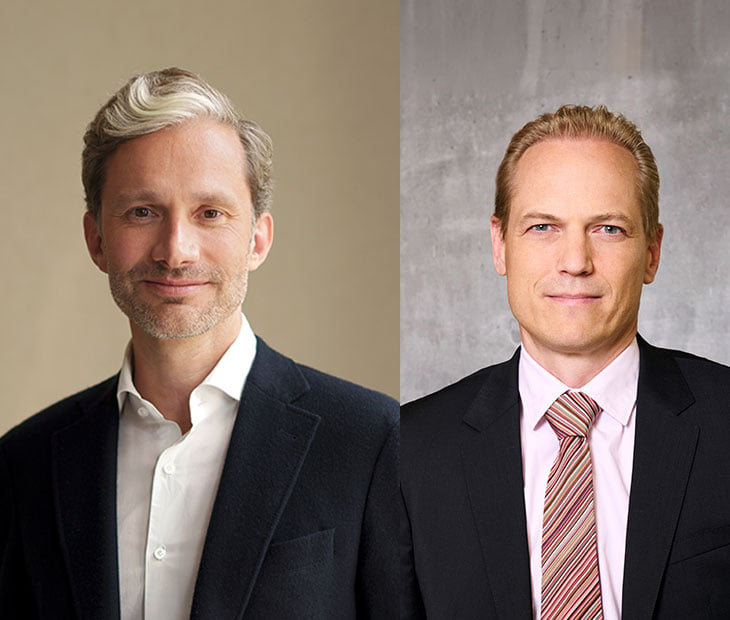
Martin Ewald
Managing Director of SCALED Development
Managing Director of SCALED Development

The company operationalizes the SCALED initiative (Scaling Capital for Sustainable Development), a global public-private platform that brings together six governments — Canada, Denmark, France, Germany, South Africa and the United Kingdom — alongside four institutional investors: Allianz, AXA, La Caisse and Zurich. The OECD and IDB Group support SCALED as knowledge partners while GIZ sponsors the secretariat. The coalition seeks to mobilize billions in private capital for sustainable development in emerging markets.
Martin Ewald, managing director of SCALED Development, and Dr. Udo Riese, head of sustainable investing at Allianz Investment Management, explain why the platform is needed, what makes the partnership different and how to measure success.
Martin Ewald: Not exactly. Capital exists. Emerging markets have genuine investable needs: renewable energy, sustainable infrastructure, transport and more. The problem is not scarcity — it is architecture.
Blended finance brings public and private capital together in a single structure. Public funders — governments or development banks — provide capital that absorbs risk, making it safer for private investors to participate. In theory, this is an elegant solution.
In practice, each structure is typically built from scratch. Public funders bring different mandates, reporting rules and restrictions. Private investors bring their own risk, return and operational requirements. Asset managers must reconcile all of this with project realities on the ground. The result is a process that takes years — years during which communities wait for clean water, reliable electricity or flood protection. That is the real cost of a fragmented system.
Udo Riese: For an insurer like Allianz, the starting point is non-negotiable: we invest policyholders' money. That means strict requirements on governance, return, risk and transparency.
Many emerging market investments do not fit that profile. Currency volatility, uncertain legal systems and laws that are hard to enforce make them difficult to assess — even when the underlying assets are sound. A windmill built in Kenya is the same as a windmill built in the UK, and wind is the same too. As Martin said, the problem is the investment architecture.
Martin Ewald: Think of SCALED as moving the market from bespoke tailoring to premium ready-to-wear.
In my previous work, I built two blended finance funds — one for global infrastructure in emerging markets and one for private equity and venture capital in Africa. Despite similar goals, they were completely different: different legal structures, different capital types, different governments and requirements. Lessons from one did not necessarily transfer to the other, and each took time to build. That is the norm in this market.
SCALED develops blueprints. Working with public and private partners, it creates standardized frameworks, common reporting and reusable structures. Not every component transfers — markets and managers differ — but if 70–80% can be reused, the cost and time of deploying capital drop dramatically.
That is what makes SCALED different: it is an institutional learning machine. Every time we resolve a reporting conflict or crack a structuring problem, that solution becomes part of the platform — available for the next vehicle which might be run and invested by a different investment partner on the ground. In private markets, knowledge is usually trapped inside individual deals or teams. SCALED breaks that cycle.
Crucially, SCALED is not a competitor to asset managers, public funders or investors. It is connecting infrastructure that makes the whole system work better: aligning interests early, identifying where public and private capital can combine, and connecting the right investors with the right teams.
Udo Riese: Allianz is one of SCALED's private-sector partners and shareholders. This is not a conventional financial investment — it is a strategic commitment to help reshape how the market works.
The logic has roots inside Allianz. We have long used fund structures where multiple asset managers operate within a shared legal and operational framework. That saves significant time and cost. The question was whether the same principle could work in blended finance — and SCALED is the answer.
That said, this cannot be led by the private sector alone. Public capital is structurally central to blended finance, and SCALED's credibility depends on the strength and balance of its members. Allianz brings investor discipline, operational experience and a signal to the market that institutional investors are serious. But Allianz is one voice among many — and that balance is precisely what makes SCALED credible.
Martin Ewald: Trust, above all. The joint ownership structure — governments and private investors co-owning the platform — fosters openness that a purely private or purely public vehicle cannot replicate. Both sides speak openly about their needs because both have skin in the game.
Udo Riese: It also produces concrete breakthroughs. For the first time, governments in the coalition are aligning their junior capital requirements — the public money that absorbs first losses, protecting investors — with one another. This is a small technical step, but a meaningful one. A fund manager can now apply the same playbook across multiple public partners rather than renegotiating from scratch with each. That kind of alignment does not happen without a shared institutional home.
Udo Riese: It is not philanthropy. The distinction matters. We need risk-adjusted returns that justify deploying policyholders' capital. Allianz also has sustainability objectives. To put our current exposure in context: Allianz has more than ten years of experience in blended finance, but with minimal impact on our portfolio or the real world. We want to change that.
If SCALED works, it opens opportunities that were previously inaccessible — not because the underlying assets lacked value, but because the structures around them were too slow and too bespoke to assess. Better structures unlock better access.
The deeper point is that commercial logic and impact logic are not in conflict. Countries need capital for development and climate goals. Private investors need structures with appropriate risk-return profiles. None of this works without the others. SCALED is designed to make those interests interlock — and if it succeeds, it can help prove that sustainable development finance can work as a mainstream asset class, not a niche one.
Martin Ewald: Definitely too early. The founding is a milestone, not the finish line. If in three years SCALED has become a functioning institution — not just a promising initiative — with several vehicles built, genuine standardization established and a reliable path to two funds per year, then we can use the word ‘success.’
Udo Riese: For SCALED to succeed, I would look at three things:
But the ultimate measure is simpler: Are more communities getting access to clean energy, clean water and resilient infrastructure faster than they would have without SCALED? If the answer is yes, that is when we break out the champagne.
Swipe to view more
| Key Facts | SCALED Development (GmbH) |
| Launch | June 2026, Hamburg Sustainability Conference |
| Purpose | Create scalable blended finance vehicles to mobilize private capital for sustainable development |
| Initial shareholders | Allianz, Zurich, KfW (on behalf of Germany), FinDev Canada (on behalf of Canada) |
| Success metrics | Halve deployment time (from on average 5 to 2.5 years) and double fund size (from on average EUR 500 million to above EUR 1 billion) within the next three years |


Last updated: September 23, 2026
The Allianz Group is one of the world’s leading insurers and asset managers, active in almost 70 countries and serving around 97 million private and corporate customers*. Our customers benefit from a broad range of personal and corporate insurance services, including property, life and health insurance, as well as assistance services, credit and global business insurance. Recognized for the seventh consecutive year as the number one global insurance brand in Interbrand’s Best Global Brands 2025 ranking, Allianz’s success is built on technology-enabled customer centricity – providing peace of mind, protection, and prevention for our customers and strengthening the resilience of individuals, communities, and societies. We are one of the world’s largest investors, managing around 791 billion euros** on behalf of our insurance customers. Furthermore, our asset managers PIMCO and Allianz Global Investors manage about 2.2 trillion euros** of third-party assets. Thanks to our systematic integration of environmental and social criteria in our business processes and investment decisions, Allianz received an MSCI ESG Rating of AAA (as of March 2026). In 2025, our 156,000 dedicated employees achieved a total business volume of 186.9 billion euros and an operating profit of 17.4 billion euros for our shareholders.
* As of December 31, 2025. Customer count reflects Allianz customers in consolidated entities that are part of the customer reporting scope only.
** As of June 30, 2026.
.jpeg)