Empowering vulnerable populations: Allianz's parametric insurance

By Ivana Kovacevic
Senior Editor at Allianz SE

Video: Nicolas Roa Santofimio
Infographic: Wilson Gotardello Filho
Additional contributors: Helena Rauch

Today’s climate actions must focus on building resilience to the impact of climate change, such as floods, droughts, and wildfires. Climate resilience improves recovery, physical safety, and economic stability. Insurance can be a leader and partner in risk mitigation and adaptation. Parametric insurance provides immediate financial relief with fast, predictable payouts based on predefined triggers, ensuring timely support in today's volatile risk landscape.
Parametric insurance, with roots dating back to the 1800s, has evolved from simple predefined triggers to sophisticated models enhanced by AI (Artificial Intelligence) and data analytics, offering more personalized and efficient insurance solutions. Unlike traditional insurance solutions, which compensate for assessed damages, parametric insurance offers payouts based on the occurrence of predefined triggers related to a defined event, such as seismic activity for earthquakes or wind speeds for hurricanes. This type of insurance is designed to complement traditional policies, addressing coverage gaps, and reducing overall risk exposure.
Parametric policies are triggered when predetermined parameters—such as the magnitude of an earthquake or specific rainfall thresholds—are met or exceeded. These parameters  leverage on   data from reliable and objective third-party sources. When a specified trigger is met, the insurance policy automatically releases a payout, providing quick compensation without lengthy claims processes. This predefined payout structure ensures policyholders know what to expect, aiding in better financial planning and immediate disaster response.
  • Effective insurance solutions: Allianz uses parametric insurance solutions to provide swift financial relief based on specific, measurable events like earthquakes, hurricanes, or rainfall.
  • Complementary coverage: Parametric insurance is designed to complement traditional policies, addressing coverage gaps and enhancing overall risk management.
  • Real-world impact: Examples include Allianz’s support to UNICEF’s Children Cyclone Index, agricultural support in Colombia, and weather resilience for farmers in Ivory Coast.
  • Sustainability focus: Allianz's parametric solutions align with our goals, offering critical support to people at risk from climate-related disasters vulnerable communities and enhancing climate long-term resilience.
  • Technological integration: The use of advanced data analytics and AI helps refine risk assessments and expands the scope of parametric insurance coverage.

Parametric insurance offers several key benefits:
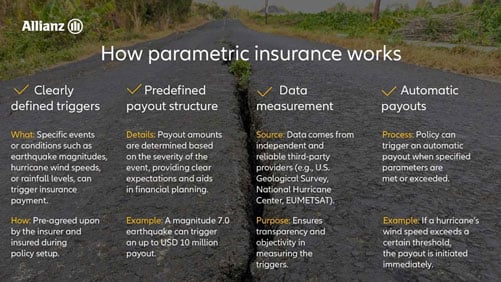
  • Speed and efficiency: Payments are swiftly triggered by the measurable occurrence of the predefined event, ensuring a fast distribution of funds crucial in disaster recovery.
  • Simplicity and accessibility: The straightforward nature of parametric policies makes them easy to understand and manage, reducing thereby the administrative burden.
  • Certainty and transparency: Policyholders are aware of the exact payout they will receive if conditions are met, facilitating better financial planning and recovery efforts.

Allianz has embraced the challenges of today’s complex risk landscape by adopting parametric solutions to fill the gaps left by traditional insurance  This approach is particularly effective in regions that are either vulnerable or under-served by conventional insurance. By offering quick, predetermined payouts based on measurable events, Allianz's parametric solutions provide crucial support to communities and businesses, enhancing resilience and sustainability in the face of adversity.

A notable example of Allianz’s parametric insurance application is the support given to UNICEF’s (United Nations Children's Fund) program. This arrangement uses the Children Cyclone Index to activate funding based on cyclone intensity and the potential impact on children, ensuring necessary measures are in place to protect them during such events. This innovative index combines meteorological data on wind speeds with demographic information to assess the vulnerability of children in affected areas. 

“This is a great example of how Allianz can support aid agencies responding to those in need when an extraordinary disaster occurs, removing uncertainty about the financing in critical times,” says Grant Maxwell, Global Head of Alternative Risk Transfer (ART) at Allianz Commercial.

In Colombia, unpredictable weather threatens avocado and coffee crops, vital to the rural population. “Less than 3% of the more than seven million arable hectares in the country are insured against climatic eventualities,” says Esteban Delgado, Managing Director, Allianz Commercial, Colombia. “Crop failure can spell financial disaster for farming families.”

Allianz’s parametric agricultural insurance solution uses satellite data to monitor rainfall and trigger payouts when levels threaten crops. “Our own capital and sometimes credit is invested in our farms,” says Yovani Rodriguez, a local farmer. “By having this insurance in place, we know that when we are hit by damaging weather, our investments can be protected, if not 100%, then certainly in large part.”

So far, the insurance has protected over USD 1.5 million in investments, covering 390 hectares across 45 municipalities. Allianz's innovative solutions, developed with partners like Bancolombia, highlight the company’s commitment to sustainability. “Parametric solutions offer great potential to address the ‘protection gap’—the disparity between economic losses and insured losses,” says Lena Fuldauer, Global Sustainability and Resilience Lead at Allianz Commercial.


In Ivory Coast, Allianz's weather insurance utilizes the ESA Soil Water Index to provide critical coverage against drought and excessive rainfall. This advanced approach uses real-time soil moisture data to trigger automatic payouts, offering timely financial support to local cocoa farmers. Marcel Stäheli, Client Manager and Underwriter of Agriculture at Allianz Re, notes, "The precision of this technology ensures that our farmers can continue their work with confidence, knowing they are supported by robust, responsive insurance solutions."

This innovative insurance significantly impacts local economies by enabling farmers to secure loans and maintain productivity. In 2022, Allianz Côte d’Ivoire sold 444 policies with the help of OKO Finance, and by early 2023, the number already reached 1,015. By providing a reliable safety net, Allianz helps farmers invest in better agricultural practices, boosting productivity and income stability.

Ghana has experienced more than 30 major floods since 1955, severely affecting more than 4.5 million people. The 2015 flood in Accra was particularly devastating, causing 150 deaths and US$55 million in infrastructure damage. In response, a Tripartite Project, co-led by Allianz and co-funded by the InsuResilience Solutions Fund, has been established to develop a parametric flood insurance solution to quickly re-establish economic activity in low-income urban areas. The centerpiece of the project is a satellite-based Flood Footprint (FFP) Cover as the primary solution, with a basic Excess Rainfall Cover as a backup. 

Launched in June 2022, the project aims to increase Ghana's climate resilience by providing tailored parametric flood insurance for the capital city of Accra, with an estimated benefit to approximately 1.6 million policyholders. The United Nations Development Programme (UNDP) is supporting the  Ghanaian government in developing a contingency plan to ensure payouts are used effectively. The government is expected to decide on product implementation and launch by Q4 2024.


While parametric insurance offers numerous advantages, it is not without its challenges. Alongside scarce  education and awareness, which refers to a situation in which the payout may not match the actual loss experienced, remains another often-cited concern. Addressing this involves carefully designing insurance triggers which more closely match the expected potential damages. 

The success of parametric insurance is also dependent on the accuracy and reliability of data used to set triggers. To ensure data accuracy and reliability, Allianz works with trusted global data providers.

As the global landscape evolves, so does the spectrum of risks faced by businesses and communities. Allianz recognizes this shifting paradigm and continues to explore the potential of parametric insurance further. 


Parametric and weather index insurance are innovative insurance products designed to provide rapid payouts based on predefined indices rather than actual losses incurred. Parametric insurance products trigger payouts when specific parameters, such as earthquake magnitude, hurricane category, flood levels, wind speed, commodity price index, pandemic triggers, or crop yield indices, exceed pre-agreed thresholds. These parameters are not exclusively weather-related and can include a variety of underlying factors. In contrast, weather index insurance is a subset of parametric insurance that specifically ties payouts to weather-related indices. Common applications include temperature indices (Heating Degree Days and Cooling Degree Days), rainfall or soil moisture indices, snowfall indices, wind speed indices, humidity levels, and vegetation indices such as Normalized Difference Vegetation Index (NDVI) and Enhanced Vegetation Index (EVI), which are critical to sectors such as agriculture and energy. The primary difference lies in the scope of the underlying indices: parametric insurance covers a broader range of triggers, while weather index insurance focuses solely on weather-related metrics.

The Allianz Group is one of the world’s leading insurers and asset managers, active in almost 70 countries and serving around 97 million private and corporate customers*. Allianz customers benefit from a broad range of personal and corporate insurance services, ranging from property, life and health insurance to assistance services to credit insurance and global business insurance. Allianz is one of the world’s largest investors, managing around 764 billion euros** on behalf of its insurance customers. Furthermore, our asset managers PIMCO and Allianz Global Investors manage about 2.0 trillion euros** of third-party assets. Thanks to our systematic integration of ecological and social criteria in our business processes and investment decisions, we are among the leaders in the insurance industry in the Dow Jones Sustainability Index. In 2025, over 156,000 employees achieved total business volume of 186.9 billion euros and an operating profit of 17.4 billion euros for the Group.

* Customer count reflects Allianz customers in consolidated entities that are part of the customer reporting scope only.

** As of December 31, 2025.

As with all content published on this site, these statements are subject to our cautionary note regarding forward-looking statements:
Choose an element

Choose an element

Choose an element

Choose an element

Choose an element

631 results

Sep 30, 2021

Changes to the Allianz SE Board of Management

Allianz SE announces that Jacqueline Hunt wishes to step back from her day-to-day responsibilities as Member of the Board of Management and has been appointed a strategic consultant to Oliver Bäte, Group Chief Executive. Andreas Wimmer, currently the chief executive officer of Allianz Lebensversicherungs-AG (“Allianz Leben”), has been appointed as Member of the Board of Management to succeed Ms. Hunt.

Feb 10, 2022 | Corporate Management, Media release

Jim Hagemann Snabe resigns from the Supervisory Board of Allianz SE

Jim Hagemann Snabe will not stand for re-election to the Supervisory Board of Allianz SE. He will resign from the Supervisory Board upon expiry of his mandate.

Jul 21, 2021

Allianz announces change of personnel

Lauren Day will serve as the company’s new Global Head of Communications and Reputation as of August 1, 2021. Day joins Allianz SE from Annycent Capital, a newly incorporated Luxembourg-based private equity firm focused on renewable energy infrastructure in emerging markets, where she was Head of Strategy and Capital Relationships.

631 results

EIB and Allianz support climate action projects in emerging and developing countries

The new strategy has a target size of €500 million. Its investment criteria is based on EU taxonomy for sustainable activities. It is an impact investing initiative for Africa, Asia, Latin America and the Middle East.

The net-zero problem: We're not going far enough

In an op-ed in Investment Week, Günther Thallinger, a member of the Board of Management of Allianz SE and chair of the UN-convened Net-Zero Asset Owner Alliance, argues that while progress has been made in getting governments and companies to set long-term decarbonization targets, it is interim targets that will lead to real world outcomes.

IFC and Allianz Group enter partnership for 1.5°C-aligned investments in emerging markets

It is the world’s first cross-sectoral portfolio of emerging market loans in line with Paris Climate Agreement. Blended finance instruments are key for underfinanced markets to grow on a net zero emission path. Financing climate-smart business models complement Allianz’s net zero commitments