
Twelve-time Paralympic gold medalist Verena Bentele knows what it means to overcome limits. At Allianz Motor Day 2025, she shared her thoughts on how autonomous driving could open new horizons for people with disabilities and why inclusive mobility is key to a safer, more accessible future.

Allianz Motor Day 2025
HANDS OFF – The Safety Promise of Autonomous Driving
Exploring how automation, innovation, and insurance are driving a safer, more inclusive mobility future.
This year’s Motor Day explores the evolving landscape of automated mobility, its implications for road safety, and the insurance industry’s role in building trust in autonomous technologies. As vehicles transition from driver assistance to highly automated systems (Levels 3 and 4), Allianz is helping ensure that innovation translates into real-world safety.
Drawing from decades of research at the Allianz Center for Technology and consumer surveys, Allianz combines global expertise with forward-looking insurance solutions to support a responsible and inclusive mobility future.

Paralympic champion Verena Bentele on the future of autonomous driving
Media
Key take-aways from Motor Day 2025
Dive deeper into innovations, highlights, and expert perspectives shaping this year's event. Explore the full report and the official press release for all details and analyses from Motor Day 2025.
-
Safety perception
-
Concerns & trust drivers
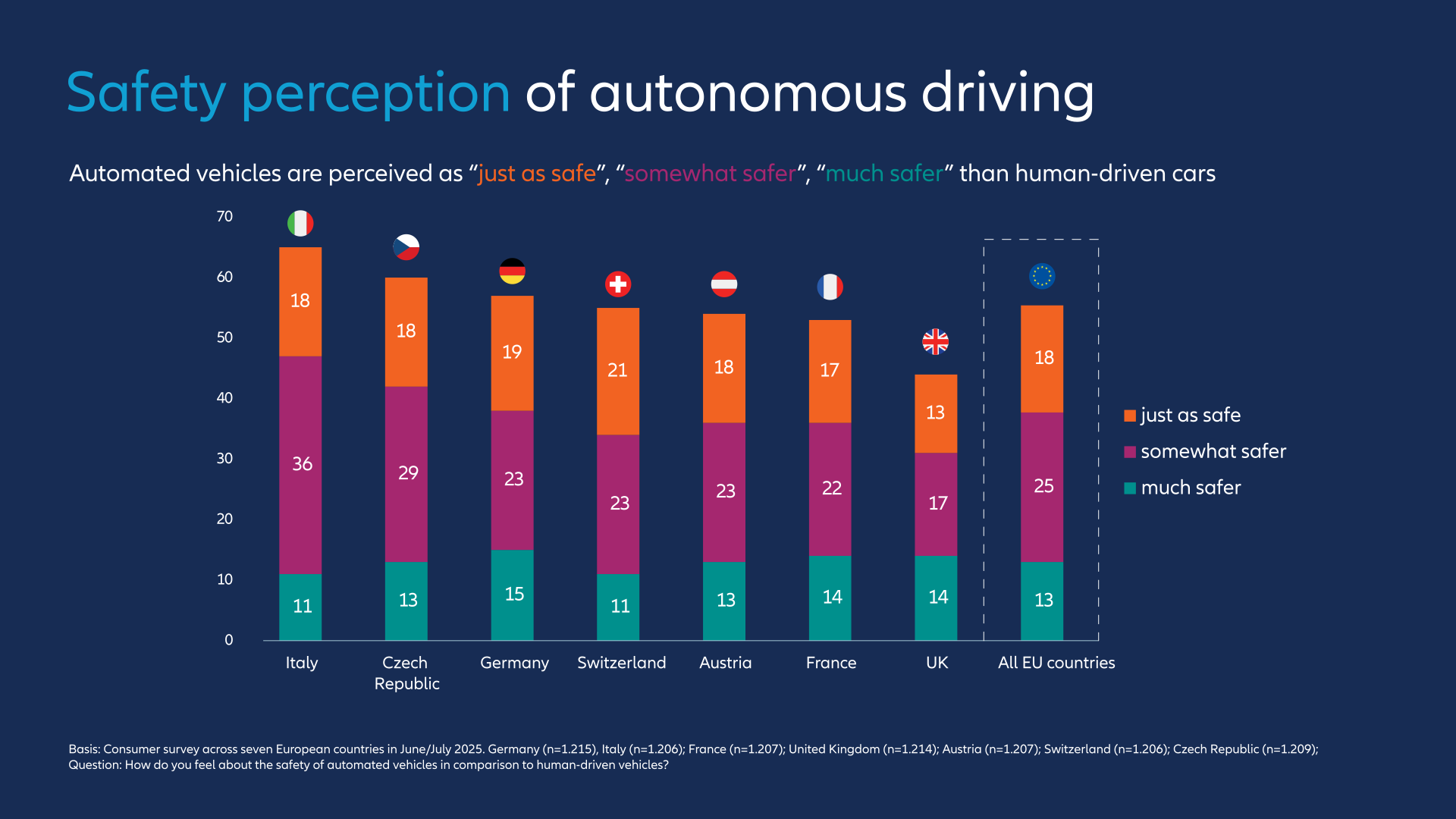
Safety perception of autonomous driving
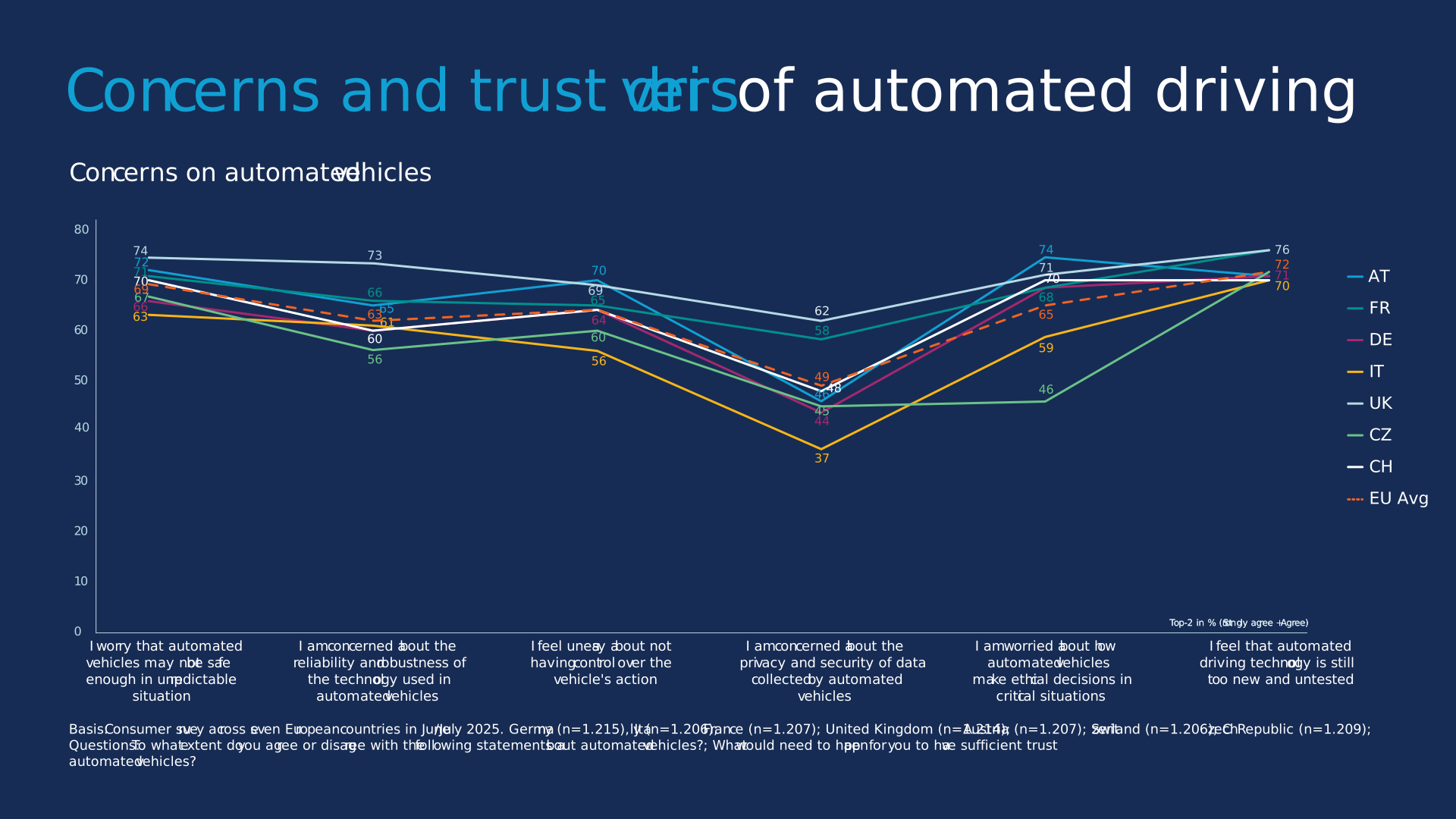
Concerns and trust drivers of automated driving – concerns of automated vehicles

“Autonomous mobility is no longer a question of if. It is about how fast, how safe and how fair. Every technological advancement must translate into fewer collisions, fewer victims, and greater independence for millions. At Allianz, we see autonomous driving as a shared responsibility to build safer and more inclusive mobility. Together with the Allianz Center for Technology, manufacturers and regulators, we will shape safety standards and pilot innovative insurance solutions. The future of mobility will be autonomous, but safety must always remain in human hands.”
Dr. Klaus-Peter Röhler, Member of the Board of Management of Allianz SE, Insurance German Speaking Countries, Central Europe, Global Property & Casualty

Our experts on autonomous driving and insurance
Exploring interviews and insights from our experts
-
Dr. Klaus-Peter Röhler
-
Frank Sommerfeld
-
Dr. Lucie Bakker
-
Matthias Trüstedt
-
Susan Sahl Poynor
-
Dr. Christian Sahr
-
Dr. Michael Praxenthaler

Insights
Dr Klaus-Peter Röhler,
Member of the Board of Management of Allianz SE, Insurance German Speaking Countries, Central Europe, Global Property & Casualty
Read Dr. Klaus-Peter Röhler’s take on the global evolution of autonomous mobility and its implications for road safety and insurance.

Insights
Frank Sommerfeld,
CEO of Allianz Versicherungs-AG
The world is on the cusp of a new era of mobility, redefining how people and societies move. What once lived in labs and test tracks is now driving on our roads. Autonomous driving is no longer an experiment: it is becoming reality.
Level 3 vehicles can already be found on European roads, while Level 4 pilots – those that operate entirely autonomously within defined environments – are already in operation in cities from Hamburg to Austin and from Beijing to San Francisco. Allianz is already insuring pilot zones and test fields in Singapore, Oslo, and Germany, helping turn prototypes into safe, real-world services – and this is only the beginning.
Such progress comes with profound questions. How will autonomy transform safety and public trust? How can it widen access to mobility for those previously excluded? What will it mean for sustainability, for the design of our cities, and for the sharing of responsibility when accidents occur?
As one of the world’s leading car insurers, we at Allianz have a responsibility to confront the opportunities and risks of autonomy with clarity and evidence. The Allianz Zentrum für Technik (AZT), together with our own claims analysis, confirms that automation can sharply reduce accidents caused by human error – specifically, fatigue, distraction and misjudgment, which remain the root cause of most collisions. But our findings also reveal an important truth: safety gains are greatest when technology is widely deployed. Progress follows from ambition, not hesitation.
Yet safety alone does not capture the full potential of autonomous mobility. This is also a story about independence – for older adults travelling to medical care, for young people moving safely between school and home, for rural communities better connected to opportunity. It is about environmental responsibility – quieter streets, fewer emissions, smarter logistics. It is about inclusion – creating a system that works for more people, more of the time.
For these promises to take hold, trust must be at the center. Our recent survey shows Europeans are curious but cautious. They want not perfection but proof: open data, strong oversight and clear accountability. Allianz believes one of the principles to ensure this is simple. Victim protection must remain paramount.
Liability should remain with the vehicle owner, while insurers act as an independent safeguard, ensuring that causes are investigated fairly and compensation is delivered swiftly. However, for this model to work, access to accident- and safety-critical vehicle data must remain unrestricted. Without accountability, trust cannot grow.
Autonomous mobility will also reshape insurance. Fewer accidents will mean fewer claims; yet the value of each claim will rise as vehicles become more technologically complex. New forms of risk – from software failures to cyberattacks – will demand new kinds of cover. Allianz is already adapting, redesigning products and pricing so that customers benefit from safety improvements while remaining protected against emerging threats.
Europe now faces a strategic choice. To make autonomy safe, scalable and trusted, we need a harmonized legal framework, sovereignty over critical data and a European licensing model for autonomous systems that not only specifies the requirements an autonomous vehicle must meet but also sets out which simulations and tests it must pass.
At Allianz, we are committed to helping build that future, not only by insuring risk but also by enabling progress, turning complexity into clarity, and ensuring that autonomy delivers on its extraordinary promise.
Interview
Dr. Lucie Bakker
Board Member of Allianz Versicherungs-AG for Claims
Autonomous driving in motor claims: fewer bumps, pricier fixes
Lucie Bakker, Board Member of Allianz Versicherungs-AG for claims, discusses how automation will change accident patterns, repair bills and data needs across Europe.
What developments in the field of motor claims can be expected in connection with autonomous driving?
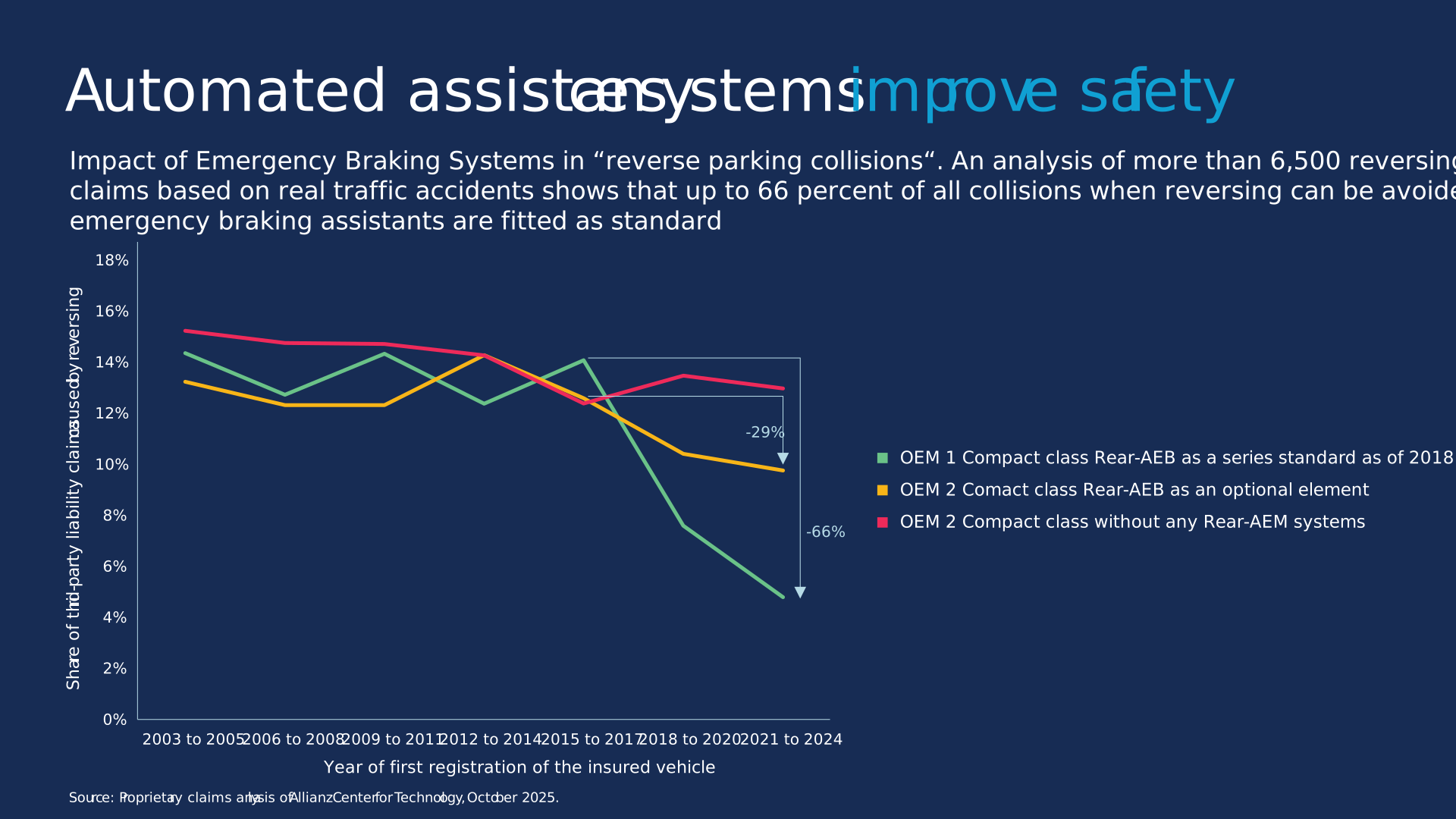
We are confident that the widespread adoption of relevant driver assistance systems has significant potential to reduce the occurrence of certain types of accidents. This is already evident in the latest studies by the AZT, which show that the number of collisions when reversing can be reduced by up to 66% when appropriate autonomous emergency-braking systems are installed. Another factor is claim costs. If an accident occurs despite assistance systems, we expect higher damage costs, as repairs tend to be more expensive.
Why are AVs repairs getting more expensive?
AVs require numerous sensors to function, many of which located in areas of the vehicle at risk of collision. Accordingly, additional costs are likely in the event of damage – for replacement or at least calibration of these sensors. These ADAS sensors serve as the ‘eyes and ears’ of the vehicle, comprising radar, lidar, cameras and ultrasonic sensors, which enhance safety and driving comfort through features such as adaptive cruise control and lane-keeping systems. Spare part prices for ADAS sensors can range from under EUR 100, for example, an ultrasonic sensor, to several thousand EUR for lidar sensors or night vision cameras. Calibration adds work in the body shops, ranging from a few minutes to several hours, depending on the respective vehicle manufacturer and model.
What role will data access play in claims handling and customer trust?
Data access is key to fair and efficient claims handling in autonomous driving. It enables insurers to understand what happened quickly, determine liability, and protect victims – without uncertainty or delay. Allianz therefore advocates for transparent and secure data sharing among carmakers, insurers and regulators. And drivers see it the same way: in a recent survey conducted by Allianz in seven European countries, about six in ten respondents said that it was important to them to know which country their data was stored in. That is why a secure and harmonized EU data framework is essential for building lasting trust in this technology.

Interview
Matthias Trüstedt,
Global head of Allianz Global Property & Casualty (P&C),
Allianz SE
Driving liability in the future
Matthias Trüstedt, Head of Allianz Global Property & Casualty (P&C), discusses navigating liability, affordability and opportunity in the age of autonomous mobility.
How do you see liability evolving as autonomous vehicles move from pilots to mass deployment?
Autonomous mobility is a complex and fast-moving ecosystem highly relevant to our business. It involves many different actors, such as original equipment manufacturers, AI providers and fleet or technical supervision operators, each with liability exposures.
We believe that strict liability will remain the most viable solution across the European Union and many other countries, including China. It offers comprehensive victim protection, clear accountability and a manageable way to address the inherent complexity of claims. That complexity results from multiple root causes, ranging from hardware or software errors, driver negligence and poor maintenance to wear and tear (for example, tire wear) and external factors such as storms, hail or marten bites.
Technical excellence in insurance and the right product proposition will remain key. This means understanding risk drivers, such as software reliability, sensor precision and cybersecurity threats, and evolving motor third-party liability insurance to reflect the risk shift from human to automated systems.
A motor insurance system with functions and processes comparable to today, including adequate risk assessments, pricing, product offerings and claims management, will provide the most effective and efficient solution.
Do you see AV insurance as a threat to the traditional motor business – or an opportunity to grow into new mobility ecosystems?
The disruption of autonomous mobility to classic motor insurance is both a fundamental challenge and an opportunity; we are well placed to remain successful.
Regulation is evolving rapidly in our core markets, with liability shifting between owners, operators and manufacturers. However, we expect third-party liability insurance to remain mandatory in key markets for self-driving solutions and autonomous mobility. The transition from human-centric vehicles to fully autonomous systems without human intervention will take many years and will be as interesting as challenging. We refer to this as the “mad middle” of mixed traffic.
To address these challenges consistently across Allianz, we have established the new Center of Competence for Motor & Mobility. Global P&C works with major Allianz Operating Entities, the Allianz Center of Technology and Allianz Partners to build the skills and forward-looking expertise for smart & decisive action.
We take a holistic approach, covering motor third-party liability while incorporating product liability, professional indemnity and cyber elements into a future product that offers comprehensive customer protection.
How can insurers ensure that premiums remain affordable as repair costs rise
In recent years, labor and spare part prices have risen significantly above overall inflation, driving higher claims costs and the need to increase motor premiums. This makes keeping car insurance affordable increasingly challenging. We are continuously investing to control claims cost while securing strong coverage and service for our customers:
We measure, benchmark and optimize our claims processes using best-practice frameworks to improve efficiency, effectiveness and customer service. We also invest in accident research and push for repairability to avoid costly, unnecessary replacements when there is a claim. For example, replacing an electric vehicle battery or a damaged headlight only when repair or refurbished parts are not suitable. This keeps claims costs in check, serves customers’ interests and is far more sustainable in terms of the CO2 footprint – a real win – win.
We are also strengthening fraud detection and prevention, especially as the spread of generative AI has made fraud easier and more sophisticated. We protect the interests of our honest customers and ensure they do not pay for fraudulent or unwarranted claims.
As autonomous-vehicles claims grow more complex, data access and availability will be essential for proper root cause assessment. Claims forensics will matter more to identify potential fault or faulty system components and to determine whether recourse actions against manufacturers, service providers or software providers are warranted.
Interview
Susan Poynor,
Global Head of Mobility at Allianz Partners
Embedded insurance for smarter mobility
Susan Poynor, Global Head of Mobility at Allianz Partners, discusses the role of embedded insurance and solutions for connected and autonomous vehicles.
What is Level 2/Level 2+ assisted driving, and how does adoption differ across markets?
Level 2 and Level 2+ assisted driving systems enable vehicles to control steering, acceleration and deceleration, but the driver must remain engaged and monitor the environment. This represents a significant step toward fully autonomous cars and enhanced safety. According to the latest World Economic Forum report, L2 and 2+ systems are implemented in 56% of new vehicles in China, 33% in Europe and 54% in the US.
Assisted and autonomous mobility involves carmakers, tech firms, regulators and insurers. Where do you see the greatest opportunities for collaboration?
Standardized homologation rules will enable scaling across markets, improving risk assessment and accident investigation. Cybersecurity partnerships are equally crucial for safe deployment. As insurers, we act as enablers of the shift to autonomous vehicles, developing fit-for-purpose products with mobility providers and OEMs.
How is Allianz supporting the transition to autonomous driving, and can you share some examples of pilots you have insured?
Allianz has long supported OEMs by tailoring Advanced Driver Assistance Systems (ADAS) insurance offerings in Europe. For example, we provided group insurance for Volvo’s Level 2 functions, covering motor own damage up to defined levels. Through our joint venture with Volkswagen Financial Services, we offer insurance that accounts for ADAS features to Audi, VW, Seat, Skoda and Cupra owners, reflecting the positive effect of these systems on expected claims. We also insure selected Level 4 pilots, including EasyMile shuttles and WeRide vehicles, and support smaller players such as INYO Mobility.
We see very different speeds of adoption across China, Europe, the US and other regions. What explains these differences?
China is ahead, driven by smart city initiatives and the integration of autonomous vehicles into urban planning. Europe focuses heavily on regulation and safety standards, supporting widespread adoption. The US is advanced in developing robotaxis and trucks. Cultural factors matter. Chinese consumers show more curiosity and enthusiasm, while other regions tend to be more cautious.
Looking ahead five to ten years, what will be the biggest drivers and barriers for scaling autonomous mobility?
Timelines vary by region, but L3 and L4 vehicles are expected to scale in the coming years. Mercedes and BMW already offer L3 models in Germany. In Europe, momentum is strong: MOIA plans to deploy 1000 L4 shuttles in Hamburg. Governments in China, Saudi Arabia and the United Arab Emirates target higher L4 penetration by 2030. Manufacturers are moving quickly: Waymo is scaling production, Lyft targets a 2026 Europe launch and Tesla signals a 2027 cybercab. Barriers remain – notably regulation and public acceptance – yet with significant investment and commitments from public transport operators, the outlook is dynamic.

Interview
Dr. Christian Sahr,
Managing Director
Allianz Center for Technology (AZT)
Automation’s tipping point to safer roads, shifting risks
Based on Allianz claims analysis, driver assistance systems already show a measurable impact in reducing accidents. Christian Sahr, Managing Director of the AZT, explains which technologies make the most significant difference, why public trust still trails behind technical progress, and what Europe must achieve to scale Level 4 automation.
From claims to reality: Which driver assistance systems have proven most effective in reducing accidents?
Our data show clear results. For passenger vehicles, two automated brake systems stand out. The first is front Autonomousmatic Emergency Braking (AEB), which was incentivized within the framework of the German type class system since 2013 and became mandatory for all new vehicle typesproduced passenger cars in 20222 in the EU. Even more effective isAnother effective system is Rear AEB, which activates during backing maneuvering. Since 2017, vehicles equipped with it have shown a 66% reduction in rear parking accidents compared to that year. This system significantly lowers claims frequency, influences type classes and thereby reduces cost of ownership of vehiclesinsurance premiums. Looking ahead, automated braking in cornerswhile cornering shows strong potential for protecting vulnerable road users, particularly for vans and trucks in urban areas.
Where do autonomous systems still face their greatest safety challenges?
Frankly, we do not yet know in detail – that is why we need data from large-scale test fields across Europe. Mixed traffic is a clear challenge: AVs share the road with human drivers, who may make mistakes or react unpredictably. Some reported rear-end accidents have been caused by human drivers colliding with autonomous cars. In Europe, we take a cautious approach. We require redundant sensor equipment and a combination of technologies – cameras, radar and at least one lidar sensor. Based on our data from AEB systems, however, we expect claims frequency to drop significantly as automation advances.
Which accident types remain most difficult to prevent?
In our global study of existing research, we analyzed test field data from China and the US, though much of it comes from OEMs. Still, one pattern is visibleevident: accidents involving pedestrians or cyclists in towns are drastically reduced. But However, collisions with human-driven vehicles remain stable or even increase – largely because ofdue to human error.
How do insurers balance fewer accidents against higher repair costs?
Currently, lower claims frequency is offset by higher repair bills, mainly due to the cost ofcostly sensors and rising prices for parts and labor. So, total claims costs have not fallen. But with Level 4 automation, we expect claims frequency to drop so sharply that overall claims costs will decrease, even if repair costs continue to rise.
What must be achieved before Level 4 or 5 vehicles scale in Europe?
We need harmonized homologation procedures – essentially a driving license for automated vehicles. Current methods do not allow consistent assessment, particularly for insurers evaluating risk. At Allianz, we are ready to add our own risk scoring based on claims experience as well as data from test fields to complement official approvals. Europe must move quickly: if we lag behind China and the US, we risk losing competitiveness in the technology race.

Interview
Dr. Michael Praxenthaler,
Traffic Psychologist
Allianz Center for Technology (AZT)
Autonomous driving: winning European public trust step by step
To realize the potential of autonomous mobility, people must feel confident using it. Michael Praxenthaler, traffic psychologist from the AZT, discusses the results of the Allianz Motor Day Representative Online Survey.
What were the most striking findings from the Allianz survey?
Respondents showed strong curiosity about autonomous driving and high expectations. Many emphasized potential benefits such as reduced stress, greater comfort and improved mobility for elderly or disadvantaged groups. At the same time, people are looking for more clarity on safety and reliability. This suggests that the public is open to automated mobility – but needs reassurance through information and proof points.
Did the survey show differences between countries or populations?
Overall, answers were similar across markets. Comfort and stress reduction were consistently identified as critical advantages, while safety improvements were mentioned less frequently. Italy stood out, with more respondents confident that automation could make roads safer compared with Austria and Switzerland.
Which features most influence willingness to use autonomous vehicles?
Convenience was top of mind. Respondents liked the idea of making travel time more useful and less stressful. Safety, while valued, was less frequently cited.
From a psychological perspective, what makes it difficult for people to fully embrace automated driving?
Several aspects play a role. First, most people have little direct experience with automated systems – what is unfamiliar takes longer to trust. Second, driving is closely tied to a sense of control, so handing this over to a machine feels odd. Third, accidents involving autonomous cars are highly visible in the media, shaping perception more strongly than the many uneventful journeys we take. Finally, people want to know what the car is doing and how it decides, and uncertainty here creates hesitation.
How important is transparency in building trust?
It is central. Clear communication about what systems can do – and their limits – helps people feel more secure. When interaction between driver and machine is predictable, acceptance increases.
Did experience with driver assistance systems make a difference?
Yes. Respondents with prior experience of automated driving or precursor systems who had already used functions such as lane assist or automated parking reported positive impressions and were more willing to try higher levels of automation. First-hand familiarity helps transform abstract technology into tangible safety and comfort benefits.
What risks matter most to consumers?
Everyday reliability dominates concerns. People want assurance that vehicles can handle unexpected situations. Cybersecurity and protection against hacking are also top of mind. Ethical dilemmas appear often in public debate, but for most users, consistent performance and safety are the decisive factors.
What should policymakers and industry focus on to win the European public over?
Trust needs to be earned. This requires open communication, education campaigns and opportunities for people to try the technology in pilot projects or shared mobility schemes. Insurers can provide incentives for vehicles equipped with modern assistance systems and share transparent safety data. But technical progress alone is not enough. People must experience autonomous driving as safe, useful and reliable – only then will trust grow step by step.
Automated assistance systems improve safety
Introducing Allianz Center for Technology
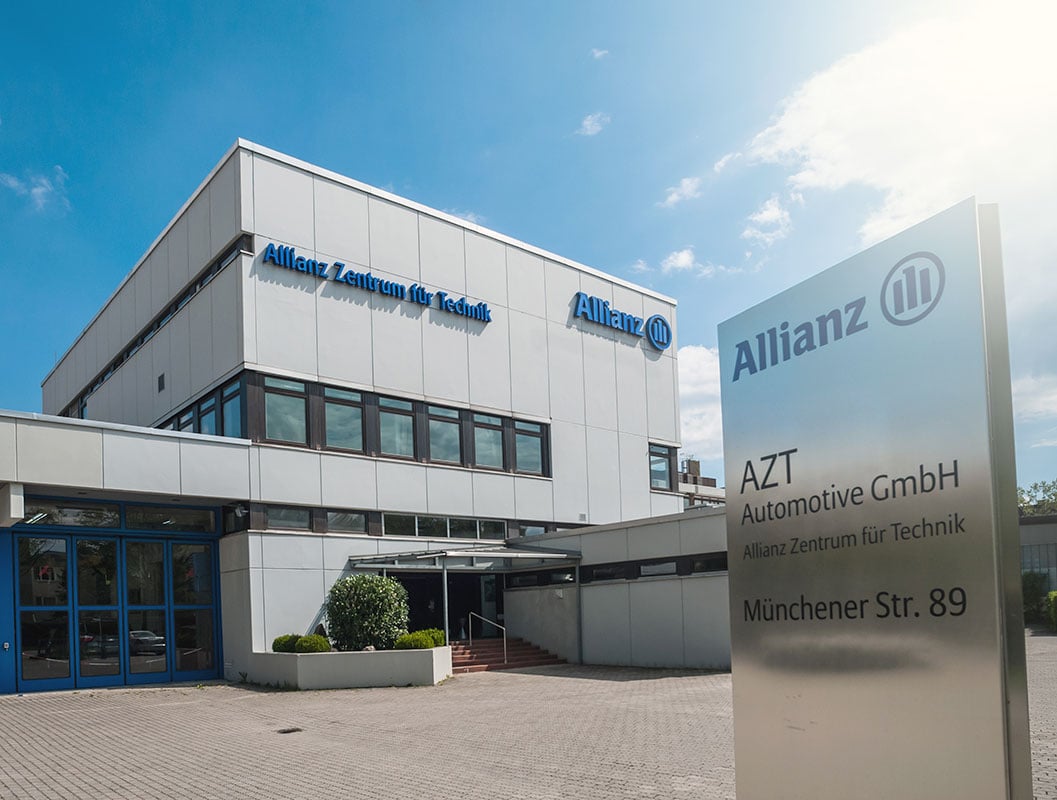
Allianz's research institute, Allianz Center for Technology (AZT – Allianz Zentrum für Technik) investigates current issues in the fields of automotive technology, repair technology, and vehicle and road safety.
The AZT has long anticipated how technological change reshapes risk and the insurance industry. In the 1970s and 1980s, it championed the introduction of mandatory seatbelts in Germany, a measure that helped reduce annual traffic fatalities from around 15,000 to fewer than 3,000 today. Later, AZT’s pioneering crash tests at low speeds revealed the high repair costs of seemingly minor accidents, laying the foundation for the vehicle type classifications that still guide motor insurance pricing.
That same forward-looking approach now informs current work on issues such as the cost of EV battery replacement, the resilience of connected cars against cyberattacks, and the liability challenges introduced by autonomous systems. The goal is to anticipate how technological shifts will influence motor insurance, road safety, and repair costs and to translate that foresight into practical solutions.
By analyzing real-world claims data, conducting crash tests, and publishing cross-market recommendations, AZT shapes industry standards and ensures claims handling that is fair and efficient for both customers and manufacturers. Its accident research projects and safety campaigns have helped make Europe’s roads markedly safer, a legacy that continues as mobility enters the era of electrification and automation.
For more than five decades, AZT has been a catalyst for change. Its mission remains constant: to create safe, sustainable, and affordable mobility for citizens while equipping insurers and policymakers to navigate the transformations ahead.
Questions? Concerns?
We look forward to hearing from you!