Ahead of the COP31 climate conference in Antalya, the second edition of the Allianz Green Transition Tracker finds that, overall, the world is progressing towards net zero, but far too slowly to meet global climate targets. The report, “The clean-tech turning point and why emissions could soon follow,” shows clean technologies beating back political headwinds, but failing to displace fossil fuels fast enough to limit global emissions in time to meet net-zero goals.
Allianz Green Transition Tracker 2026: The clean-tech turning point and why emissions could soon follow
Almost everyone is moving – but not fast enough
The Tracker scores 65 economies, responsible for 81% of global greenhouse-gas emissions, on five indicators: carbon and energy intensity, consumption- and territorial-based emissions per capita and the low-carbon share of the power mix. Its Progress Score measures how far each country has come since 2015 toward its 2050 net-zero benchmark. This year, 56 countries improved their score by 2 points on average. But only about a third of countries have kept pace with their reduction pathways aligned with the Paris Agreement. Luxembourg, Denmark and Estonia top the Progress Score ranking, and all ten front-runners are European. Colombia posted the largest improvement (+16.5 points) thanks to a hydropower rebound and new solar capacity, while Gulf oil producers remain at the bottom.
“Almost every country is moving in the right direction. The problem is the speed. Given the current trajectory net zero will only be reached in 2064 - 14 years behind schedule,” said Patrick Hoffmann, ESG Economist at Allianz Research. “And the climate-policy gap is widening, with the leaders pulling further ahead while the laggards struggle to keep up.”
A two-speed transition
Countries in the top half of the ranking gained 2. 6 points on average, almost twice as much as those in the bottom half (1. 3). The EU still leads (+2.2 points), but its emissions fell by just 0.2% in 2025 after annual cuts of 4% on average previously; at this pace, it would reach its benchmarks only in 2057. The US gained only 1.2 points and slipped to 4 1st in the Progress Score ranking as emissions rose for a second year and coal -fired generation jumped 13%. China (+2.3 points, 43rd) and India (+4.5 points, up five places to 4 5th) show signs of a turning point: China’s emissions growth slowed to virtually zero as battery electric vehicles approach ed half of new car sales, and India recorded its first emissions decline outside an economic contraction in 25 years.
Power has turned green – and clean technology keeps getting cheaper
In 2025, renewables – with a share of 3 3.5% – overtook coal (33.2%) as the world’s largest source of electricity for the first time in more than a century and supplied 99% of new generation, slowing global emissions growth to 0.7% from 1.5% in each of the two previous years. Falling costs are carrying the shift further: annual battery-storage additions surged from around 2 GWh in 2015 to 307 GWh in 2025 as installed costs dropped 91%, and the price gap between battery-electric and combustion-engine cars has narrowed from 49% to 20% since 2019. The next phase will be decided as much by grids and storage as by new capacity: clean energy investment is set to rise by 6.5% to USD2.2trn in 2026, with grid spending up 21% and storage up 36%, even as investment in renewable generation dips.
Geopolitics, not climate policy, determines prices
Geopolitics is currently sending a stronger price signal than climate policy , driving up diesel prices and demand for electric vehicles. Allianz Research calculates that matching the Iran-conflict-related rise in diesel prices through carbon pricing alone would take a CO₂ price of more than EUR200 per ton. In the EU, battery-electric cars reached 30% of new registrations in September, up 11 percentage points in a year. However, a new round of fossil-fuel subsidies, which remain arou nd 70% higher than they were before the 2022 energy crunch, poses a risk to Europe’s progress.
Outlook: an emissions peak is within reach, but a sustained decline is not yet assured
Allianz Research expects fossil-fuel CO₂ emissions to decline this year – even though the global economy is growing robustly. Cheaper clean technology and high fossil-fuel prices are the main tailwinds. Yet rising electricity demand and grid bottlenecks are the biggest near-term risks: AI and data centers alone could add around 0.6% to global emissions by 2030. High financing costs, trade barriers and policy uncertainty could slow the deployment of green technologies and throw into question the ability to reach peak emissions.
“Fossil-fuel CO₂ emissions could fall this year for the first time outside a recession, declining by around 0.5% , but that owes more to cheap clean technology and expensive oil than to stronger climate policy,” said Ludovic Subran, Chief Economist and Chief Investment Officer at Allianz. “A price shock is not a strategy. Governments should resist cushioning it with new fossil-fuel subsidies and instead lock in the shift with predictable carbon pricing and faster investment in grids and storage.”
Germany on course for net zero
Germany climbed one place to 12th in the Progress Score ranking with a score of 36.2, up 2.4 points and thus faster than both the global (2.0) and the EU (2.2) averages. The score indicates that it has covered more than a third of the distance to its net-zero benchmarks, ahead of Spain (17th), France (21st) and Italy (22nd), but behind Denmark (2nd), the UK (7th) and the Netherlands (11th). E-mobility is a clear bright spot, with EVs making up 32% of new registrations in Q3 2026, up from 19% a year earlier. Clean power, however, is losing momentum as renewable output grew by just 1.4% in 2025, down from 3. 5% a year earlier, leaving renewables’ share of the power mix flat at around 58%. At the current pace, Germany would reach net zero in 2051.
“We don’t have a problem with understanding; we have a problem with implementation. The fact that Germany has improved by just one rank to 12th place shows how far we are from our ambition of being the world champion of climate protection. We are too slow and often too timid. Yet sustainability should not be viewed as a burden, but as an economic opportunity: It can help secure our prosperity and create new growth. We have the technical expertise. What matters now is to consistently reconcile climate protection with affordability – from energy storage and the circular economy to ‘repairing instead of replacing.’ As an insurer and investor, we want to do our part,” says Frank Sommerfeld, CEO of Allianz Versicherungs-AG.
Green Transition Tracker 2026: Progress Score ranking (selected countries)
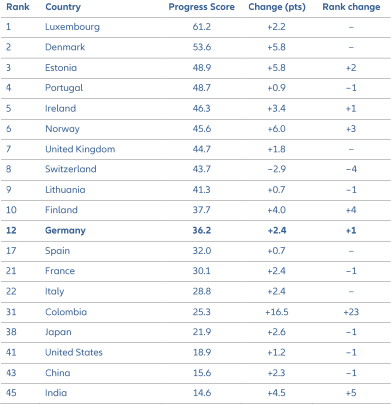
Progress Score: share of the distance from the 2015 baseline to the 2050 net-zero benchmark covered so far (0 –100). Changes compared with the previous edition on a consistent data basis. Full ranking of all 65 countries in the report. Source: Allianz Research.
Downloads
Related links
For further information, please contact:
About Allianz
Last updated: September 23, 2026
The Allianz Group is one of the world’s leading insurers and asset managers, active in almost 70 countries and serving around 97 million private and corporate customers*. Our customers benefit from a broad range of personal and corporate insurance services, including property, life and health insurance, as well as assistance services, credit and global business insurance. Recognized for the seventh consecutive year as the number one global insurance brand in Interbrand’s Best Global Brands 2025 ranking, Allianz’s success is built on technology-enabled customer centricity – providing peace of mind, protection, and prevention for our customers and strengthening the resilience of individuals, communities, and societies. We are one of the world’s largest investors, managing around 791 billion euros** on behalf of our insurance customers. Furthermore, our asset managers PIMCO and Allianz Global Investors manage about 2.2 trillion euros** of third-party assets. Thanks to our systematic integration of environmental and social criteria in our business processes and investment decisions, Allianz received an MSCI ESG Rating of AAA (as of March 2026). In 2025, our 156,000 dedicated employees achieved a total business volume of 186.9 billion euros and an operating profit of 17.4 billion euros for our shareholders.
* As of December 31, 2025. Customer count reflects Allianz customers in consolidated entities that are part of the customer reporting scope only.
** As of June 30, 2026.
Cautionary note regarding forward-looking statements
As with all content published on this site, these statements are subject to our cautionary note regarding forward-looking statements: