Will the kids be all right?

Most of us grew up with ideas that formed our sense of security, prosperity, and content. Looking at Norman Rockwell’s famous painting Freedom From Want, we mirror in our imagination what that security might look like. History fans will recall Franklin D. Roosevelt’s Four Freedoms State of the Union speech from 1941, where Roosevelt explains the third freedom, freedom from want—“which, translated into world terms, means economic understandings which will secure to every nation a health peace time life for its inhabitants—everywhere in the world.”

Historically, generations had to face different struggles to construct a future for themselves and the generations to come. 

We have long cherished the notion that all people are created equal and that notion has been a driving force in ways we constructed and continue to construct our future. Part of that notion incorporated a vision of the future in which the youth can continue to build and drive change on the solid foundations of former generations. After all, "the future belongs to young people" is an idea reflected by numerous scholars, politicians, and philosophers. 

But, what does that future hold for its protagonists in current times? 

More recently, the two young generations following each other, namely the Gen Y or the millennials (1980–1994) and the Gen Z (1995–2010), experienced and continue experiencing once-in-a-lifetime financial crises that followed each other within a relatively short timeframe. 

The Global Financial Crisis (GFC) and the Covid-19 pandemic are forces battering career prospects, delaying the initial accumulation of wealth, and forcing many into unemployment or underemployment.

The lessons of the Global Financial Crisis

A recent report published by Allianz Economic Research dives deeper into the problems of youth labor markets. Since young people's incomes depend less on career tenure or an already established earnings profile, a crisis, when it comes, usually starts with the young. 

After the GFC, the 18–24 group was most affected in terms of the net median income. Median income was chosen because it depicts a clearer picture of the middle class than mean income, since low and high earners do not skew it. Focusing on the six European countries—Germany, France, Italy, Austria, Spain and Switzerland—the data showed that the youth suffered two or more consecutive years of losses or stagnation and in some countries, like Spain, the net median income has yet to go back to pre-crisis levels.

The experience of the GFC demonstrates that entering the labor market during a recession will come with numerous challenges: a slow creation of vacancies will make the job market tighter, wages lower, and the risk of losing jobs higher.

Post-Covid-19 losses 

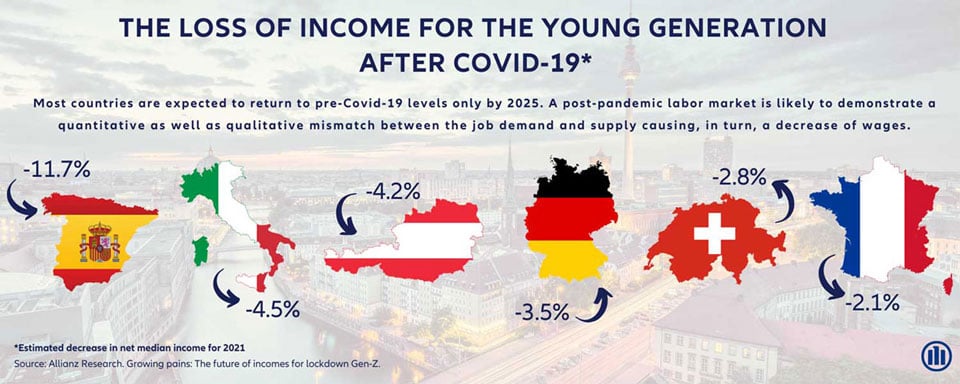
Focusing on the abovementioned six European countries and using currently available data, the report forecasts the post-pandemic loss of income for Gen Z. In Spain and Italy, the forecast scenario yields a decrease in median incomes of -11.7 percent and -4.5 percent in 2021, respectively. Germany and Austria could see a decline of -3.5 percent and -4.2 percent, respectively, while France and Switzerland might see two periods of negative growth in income.

Most countries are expected to return to pre-Covid-19 levels only by 2025, while Southern European countries face a bigger problem of "brain drain" due to the loss of competitiveness in the labor market for young people. A post-pandemic labor market is likely to demonstrate a quantitative as well as qualitative mismatch between the job demand and supply causing, in turn, a decrease of wages. 

allianz loss of income gen z future

What the future holds

Early career can determine wages for years after the first job. The working population typically increases their earnings and income as they age, peaking in their fifties. Since salary increases are a percentage of the current salary, today’s youth are bound to lose income compared to those who entered the labor market in non-crisis times. Catching up might take years and the wealth-building path between the generations might differ widely. These long-term effects on income could additionally deepen the generational conflict that has intensified in recent years amid accelerating climate and demographic changes.

To avoid a future that could be marked with permanently lower earnings and savings, and long-term unemployment, it is important to support the youth as they adjust to market changes with (re)training and (re)skilling.

A more politically active youth can connect with local representatives, who can use policy-making to address their specific needs with regard to labor market and vocational training. Because of aging populations in Europe, the voice of the older cohort is at the forefront of policy-making. Nonetheless, because of the pandemic, the EU will enact a generous and an EU-wide stimulus package. There has never been a better moment to try and right the wrongs of the past for our youth and shift toward a better future. 

The Allianz Group is one of the world’s leading insurers and asset managers, active in almost 70 countries and serving around 97 million private and corporate customers*. Allianz customers benefit from a broad range of personal and corporate insurance services, ranging from property, life and health insurance to assistance services to credit insurance and global business insurance. Allianz is one of the world’s largest investors, managing around 764 billion euros** on behalf of its insurance customers. Furthermore, our asset managers PIMCO and Allianz Global Investors manage about 2.0 trillion euros** of third-party assets. Thanks to our systematic integration of ecological and social criteria in our business processes and investment decisions, we are among the leaders in the insurance industry in the Dow Jones Sustainability Index. In 2025, over 156,000 employees achieved total business volume of 186.9 billion euros and an operating profit of 17.4 billion euros for the Group.

* Customer count reflects Allianz customers in consolidated entities that are part of the customer reporting scope only.

** As of December 31, 2025.

Press contacts

Lorenz Weimann
Allianz Investment Management SE

As with all content published on this site, these statements are subject to our cautionary note regarding forward-looking statements:

Further information

AGCS Global Risk Dialogue: ESG Risks to Watch

No one could have foreseen the challenges that 2020 brought our way. But what can be seen clearly is that some ESG risks for companies are brewing. AGCS Global Risk Dialogue identifies the five most important ESG risks for businesses this year...

Allianz Economic Outlook: Temperamental 2020

The decade has changed, the challenges have not. But some of the pain of the past couple of years may be easing. In its economic outlook for 2020, Allianz Research lists its top 10 expectations from the year...

Allianz Risk Barometer 2020: Cyber top peril for companies globally for the first time

For the first time ever, Cyber incidents (39 percent of responses) ranks as the most important business risk globally in the ninth Allianz Risk Barometer 2020, relegating perennial top peril Business interruption (BI) (37 percent of responses) to second place. Awareness of the cyber threat has grown rapidly in recent years, driven by companies’ increasing reliance on data and IT systems and a number of high-profile incidents.

Euler Hermes Global Insolvency Index: Insolvencies to rise in 4 out of 5 countries in 2020

Global bankruptcies are still on the rise, implying higher export risks: this is the conclusion of the latest Global Insolvency Report by Euler Hermes, which covers 44 countries and 87 percent of global GDP and provides the last update of its Global Insolvency Index.

Managing the increasing threat of political violence and civil unrest

With an unprecedented ‘super-cycle’ of elections in 2024, almost half the world’s populations will go to the polls before the year is out. According to a new report from Allianz Commercial, security is a concern in many territories, not only from the threat of localized unrest but because of the wider-reaching consequences of electoral outcomes on foreign policy, trade relations, and supply chains.

Gen X Approaching Retirement Crunch Time with Savings Regrets

Gen Xers, who are mostly in their late 40s and 50s, are approaching an important time in preparing to retire. Yet, Gen Xers are feeling less confident than ever about their finances and more worried about retirement than boomers or millennials, according to the 2024 Annual Retirement Study from Allianz Life Insurance Company of North America (Allianz Life).