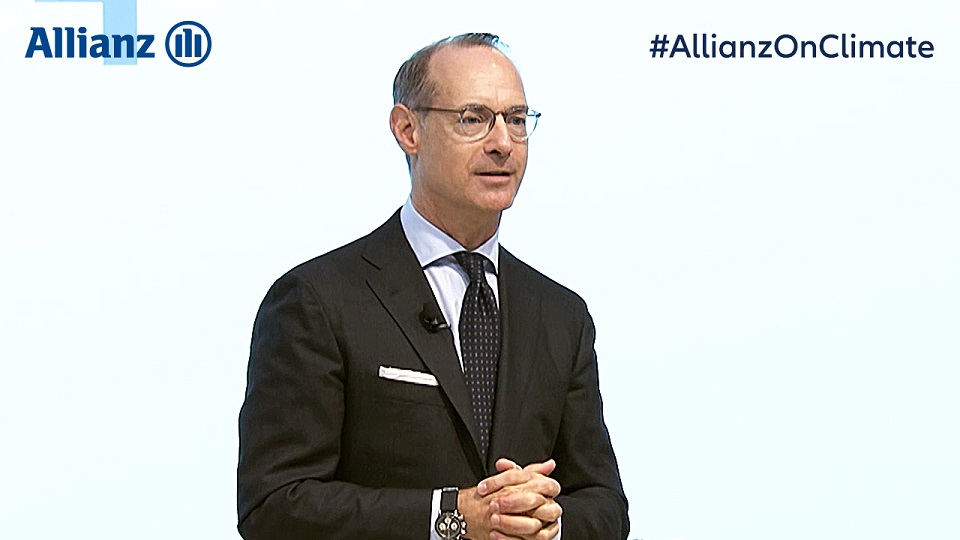
Author: Dr. Günther Thallinger is Member of the Board of Management of Allianz SE, Investment Management and Sustainability

Article by Günther Thallinger
Recharging Global Growth
By fostering strong public-private partnerships and embracing collaboration across government, business, NGOs, and academia, we can mitigate rising temperatures and spark this new era of sustainable economic growth. This requires a shift from passive compliance to proactive engagement.
Government incentives are a key catalyst—socially-conscious carbon taxes, carbon border adjustments, and a reallocation of fossil fuel subsidies to support the transition need to be at the center of the discussion.

But private companies are an important engine. To start with, businesses can become more efficient— the needed economic transformation consists largely of becoming more efficient, for example in using less material, less energy, less transport. Businesses can save by using cyclical processes, reducing or eliminating their need for new material. In addition, physical upgrades to withstand extreme weather can enhance business continuity and growth potential. To that end, climate-related capital expenditures reached a record $1.7 trillion in 2023, signaling that significant investments are already underway.
Despite this progress, only a small fraction of businesses rate their decarbonization collaboration as excellent, revealing significant room for improvement. Lawful collaboration can spark innovation, standardize reporting, and remove bureaucratic barriers to restore true economic efficiency.
In any case, speed is of the essence, as we are in the decisive decade. Speed can be gained by cooperating with clients and partners across sectors and supporting governments in defining and executing their plans. Currently, the NDCs (nationally-determined contributions) of most countries are not ambitious enough. Businesses can give confidence to both consumers and governments that a much faster pace in transforming our economies is possible.
The Net-Zero Asset Owners Alliance (NZAOA) exemplifies what’s possible through collaboration. This coalition of institutional investors has set out to reducing CO2 emissions, formulating tangible targets for 2025 and 2030. In line with the NZAOA, Allianz has committed itself to the target of net-zero emissions in our insurance business, and proprietary investments, and operations by 2050. With $9.5 trillion in overall assets, the success of the NZAOA shows that this collaborative approach works on a large scale.
To truly unlock the potential of sustainability as a driver of economic growth, we must act together. The future demands collaboration, not procrastination.
Further information
Sustainability Report 2023
Interview Günther Thallinger: Intermediate 2030 decarbonization targets
About Allianz
The Allianz Group is one of the world’s leading insurers and asset managers, active in almost 70 countries and serving around 97 million private and corporate customers*. Allianz customers benefit from a broad range of personal and corporate insurance services, ranging from property, life and health insurance to assistance services to credit insurance and global business insurance. Allianz is one of the world’s largest investors, managing around 764 billion euros** on behalf of its insurance customers. Furthermore, our asset managers PIMCO and Allianz Global Investors manage about 2.0 trillion euros** of third-party assets. Thanks to our systematic integration of ecological and social criteria in our business processes and investment decisions, we are among the leaders in the insurance industry in the Dow Jones Sustainability Index. In 2025, over 156,000 employees achieved total business volume of 186.9 billion euros and an operating profit of 17.4 billion euros for the Group.
* Customer count reflects Allianz customers in consolidated entities that are part of the customer reporting scope only.
** As of December 31, 2025.
Cautionary note regarding forward-looking statements
As with all content published on this site, these statements are subject to our cautionary note regarding forward-looking statements: