With climate change as one of the biggest global emergencies of our time, governments, enterprises, and individuals around the world are faced with the challenge of adopting more sustainable ways of living and doing business. The insurance industry has a pivotal role to play in driving the transition towards net-zero. While some measures may seem obvious (investment in renewable energies, exclusion policies and divestment, greener business operations), other ways we can make a difference are not obvious at first glance. Take claims servicing for example; here the wrong practices can be a significant source of emissions within our own supply chains.
Canning the throwaway mentality
Repair versus replace in motor insurance
Christoph, Allianz is driving a repair versus replace philosophy when it comes to servicing claims in motor insurance. Tell us what this means and why it’s better.
In Europe, we have a car fleet of about 290.55 million cars. The majority of motor vehicle collision damage is minor, affecting only the exterior – damage to windscreens, side panels, and headlights, for example. For all these damaged parts, repair methods exist, but all too often, damaged parts are disposed of and replaced with brand new components. This comes at a higher cost in terms of landfill waste and CO2 emissions, but also at a higher cost for the customer.

Dr. Christoph Lauterwasser, Managing Director, Allianz Center for Technology
The Allianz Center for Technology has undertaken research in order to quantify these savings – what does the research show?
Yes, we partnered with Oakdene Hollins / Metsims to investigate the CO2 and financial costs of repairs compared to replacement with a spare part. The numbers are striking – take a look at the cases in the infographics. Not only do we see a high emissions reduction potential for each individual part, but also a financial saving. For example, if we repair a broken LED headlight or a cracked windshield instead of replacing it with a new part, we can reduce greenhouse gases by around 99%. It’s worth noting that the financial costs and current repair rates vary across markets, but all have the potential to do more in terms of CO2 savings.
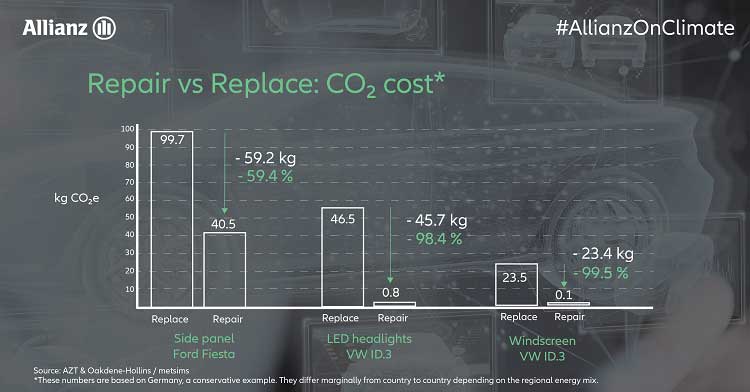
Click on the infographic to open it as a PDF.
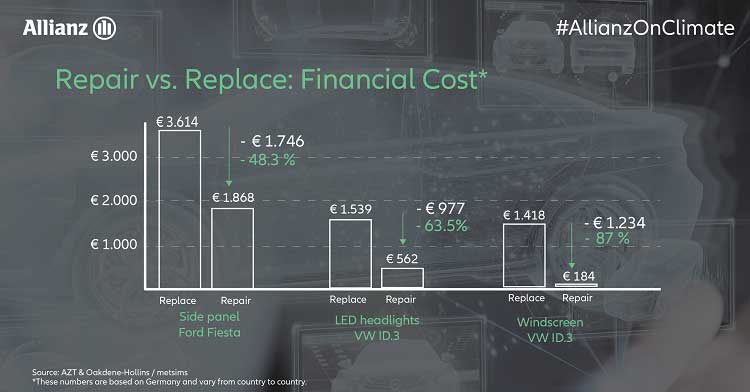
Click on the infographic to open it as a PDF.
That’s incredible. To what extent are repairs currently happening, and what’s the potential in future?
Green repair options are already being used today, but there is huge potential to increase this in future. In fact, it’s one of the sustainability levers within claims servicing with the highest potential. If we could increase the repair rates by just two percentage points, we could reduce annual Europe-wide CO2 emissions by around 30,000 tons. To put that amount in perspective, that’s equivalent to the annual energy consumption of about 5,100 households.*
Is raising repair rates by two percentage points a reasonable target?
This figure is more a conservative estimate than a target – it demonstrates the effect we could have in a reasonable amount of time if key industry players worked together to make it happen. It’s worth noting that the scale is linear. So, if we doubled that number, we would double the savings effect.
Is this the first research of its kind?
A similar study was done in 2009 already, but the market is more ready for the conversation now; climate action is high on the political agenda, supply chains for spare parts have been disrupted, and the cost of spare parts is on the rise. Our recent Allianz Motor Day was an opportunity to get the data out there and drive the discussion.
So, we are seeing a mindset change in the industry, but how’s the appetite for green repairs amongst customers? Do we still have a throwaway mentality when it comes to our cars?
We surveyed 1,260 consumers in Germany to find out exactly that. Results show that 69% of respondents expect sustainability aspects to play a role in coverage and claims settlement, and 63% say repair versus replace is an important topic. People are realizing that we need to act.
To what extent does Allianz influence the end customer in choosing a repair over a replacement?
In most cases, after a customer submits a claim, it’s over to our experts to work with partnering body shops to ensure a quality solution at a fair and reasonable cost, and it is here that we can exert most influence. That said, customer expectations still play a role in the background, and it is important that customers are aware that green repair options exist.
At the recent Allianz Motor Day, an exhibition showcased car repair examples; can it look as good as new, and are repairs as robust in the long-term?
Repairs return the vehicle to the pre-damage state and are not inferior to replacement. In some cases, especially when cutting out body parts is necessary, replacement is actually more invasive and can potentially lead to corrosion issues in the long run. So, in some cases, the repair choice can even be more sustainable. Can it look brand new? Definitely. Industry standards are adhered to, and to the end customer, the difference is invisible.
How are you partnering with car body shops to drive the transition to repair versus replace?
It is through our work with our partnering body shops that Allianz is exerting the most influence in driving a repair versus repair philosophy. Here we are working with the industry to create future standards for sustainability. These standards are crucial and will ultimately determine who we work with. A great example of body shop certification is the Green Hearts Standard introduced by LV= in the UK, which considers aspects such as carbon neutrality of the site, availability of electric vehicles as courtesy cars, and environmentally aware repairs, amongst other things.
How is the appetite for change on this side? Are green repairs also better for body shops?
There is a lot of willingness on the body shop side, and sustainability is a hot topic right now. Investment in training and the right tools is needed. One possible conflict of interest is the fact that body shops can still earn commission on new parts from manufacturers. But ultimately, it’s the responsibility of the body shop to go for the better cost choice for the end customer, and the incentive to go green is high to remain a partner of choice for insurers.
To what extent is innovation and research needed to develop new technologies for repairs?
Repair procedures are already well established, and innovation is mostly in the form of improved tools and new materials such as quick-drying paints. Paint that dries at low temperatures significantly reduces emissions.
What can be done in the case of wreckages or situations where repair is too difficult?
Here, recycling of components and reuse is key. In other words, salvaging parts and feeding them back into the value chain. If we dismantle more cars in future, we will have less landfill waste and more used parts flowing into the green repairs process. This is important given the current disruption to global supply chains and the resulting shortage of parts in the market.
Repair instead of replacement is just one of several levers for making claims servicing in motor insurance more sustainable – what are the others?
Remote inspections, remote roadside assistance, green courtesy vehicles (such as electric vehicles or even bikes in cities), as well as the introduction of body shop standards which we already touched upon. In addition to these levers in claims, another key topic for us is driving a high market penetration of electric vehicles. To do this, customer-friendly solutions are required to make electric mobility accessible to the wider public. At Allianz, we are partnering with recognized brands to create a dedicated digital platform for electric vehicles. It will be a one-stop shop where customers can find everything they need on the topic.
Do you think we will see the repair versus replace trend in other areas beyond automotive?
Definitely. It’s something we need to look at across all areas of global property and casualty insurance. It’s also an ongoing discussion in politics right now – the right to repair versus replace.
*According to the calculations of our experts. Data source for Germany.
Allianz Motor Day 2022
Related materials
How sustainable can car insurance be? Welcoming experts from the fields of science, automotive, insurance, claims, and politics, the tenth edition of the Allianz Motor Day delved into this topic. For more news and information from the event, check out the links below.
About Allianz
Last updated: September 23, 2026
The Allianz Group is one of the world’s leading insurers and asset managers, active in almost 70 countries and serving around 97 million private and corporate customers*. Our customers benefit from a broad range of personal and corporate insurance services, including property, life and health insurance, as well as assistance services, credit and global business insurance. Recognized for the seventh consecutive year as the number one global insurance brand in Interbrand’s Best Global Brands 2025 ranking, Allianz’s success is built on technology-enabled customer centricity – providing peace of mind, protection, and prevention for our customers and strengthening the resilience of individuals, communities, and societies. We are one of the world’s largest investors, managing around 791 billion euros** on behalf of our insurance customers. Furthermore, our asset managers PIMCO and Allianz Global Investors manage about 2.2 trillion euros** of third-party assets. Thanks to our systematic integration of environmental and social criteria in our business processes and investment decisions, Allianz received an MSCI ESG Rating of AAA (as of March 2026). In 2025, our 156,000 dedicated employees achieved a total business volume of 186.9 billion euros and an operating profit of 17.4 billion euros for our shareholders.
* As of December 31, 2025. Customer count reflects Allianz customers in consolidated entities that are part of the customer reporting scope only.
** As of June 30, 2026.
Press contacts
Cautionary note regarding forward-looking statements
As with all content published on this site, these statements are subject to our cautionary note regarding forward-looking statements: